
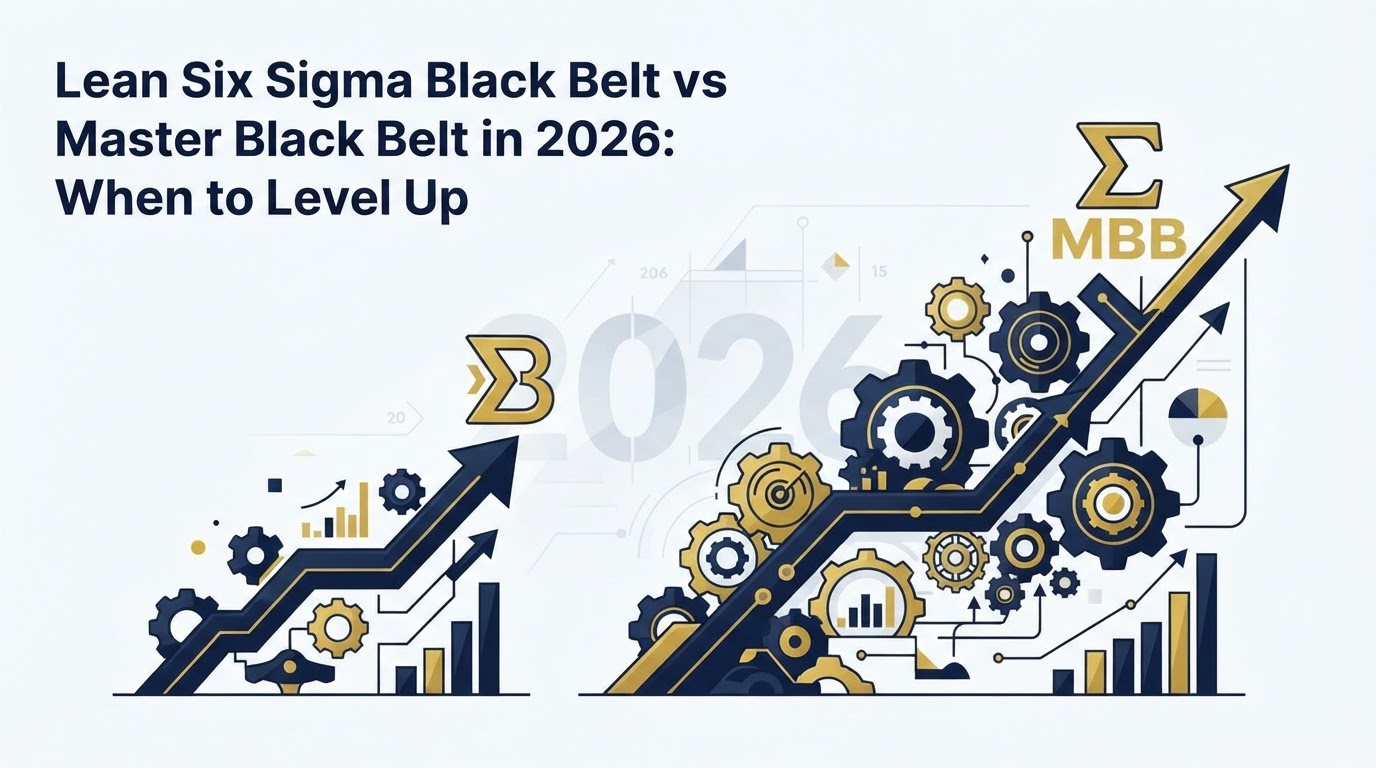
Lean Six Sigma Black Belt (LSSBB) is the delivery credential: run DMAIC projects end to end, coach Green Belts, deliver USD 100K to USD 500K in benefits per project. Master Black Belt (LSSMBB) is the enterprise credential: coach Black Belts, own the deployment strategy, deliver USD 5M to USD 25M in annual programme benefits. LSSBB prep runs 8 to 12 weeks, exam USD 295 to USD 495. LSSMBB requires 2 to 5 years post BB experience plus 2 to 4 documented projects, exam USD 495 to USD 795. Salary uplift: LSSBB 25 to 40 percent, LSSMBB 40 to 65 percent. Do not skip Black Belt experience to chase Master Black Belt, the credential loses meaning without project depth.
Save 15% on any Instructor-Led Live Online Training course, worldwide, with code HOLIDAYS15. Valid until 31 December 2026, 11:59 pm Pacific Time. See courses and savings
The two belts at a glance
| Aspect | Black Belt (LSSBB) | Master Black Belt (LSSMBB) |
|---|---|---|
| Primary role | Project lead | Programme lead + coach |
| Scope | Single DMAIC project, 3 to 6 months | Portfolio of 6 to 20 projects, annual cycles |
| Team scale | 5 to 12 people cross functional | 20 to 200 people across BB cohorts |
| Statistical depth | DOE, MSA, hypothesis testing, regression | Advanced DOE, ANOVA, GLM, Bayesian, deployment metrics |
| Coaching load | 1 to 3 Green Belts | 5 to 15 Black Belts + Green Belts |
| Typical project savings | USD 100K to USD 500K | USD 5M to USD 25M / year portfolio |
What Black Belt actually delivers
A working Black Belt owns one or two DMAIC projects at a time. They lead a cross functional team of 5 to 12 people for 3 to 6 months, run the statistical analysis themselves (Minitab, JMP or Python), coach the Green Belts on the team, and present business benefits to a Sponsor and Champion. Typical benefit per project runs USD 100K to USD 500K in cost reduction, cycle time gain or quality improvement.
By year 2, a strong Black Belt is closing 3 to 5 projects per year and coaching 2 to 3 Green Belts. That volume is the prerequisite that Master Black Belt certification bodies expect before certifying you at the next level.
What Master Black Belt actually delivers
A Master Black Belt does not run projects day to day. They design the deployment: which processes get DMAIC treatment, which get Kaizen, which need a full transformation. They set the training curriculum for Green Belts and Black Belts, coach a portfolio of 5 to 15 Black Belts, mentor Champions and Sponsors, and report programme level benefits (USD 5M to USD 25M annual savings, waste reduction, cost of poor quality) to the executive committee.
The role is 40 percent coaching, 30 percent programme governance, 20 percent statistical mentoring on tough projects, and 10 percent executive communication. If more than 25 percent of your week is spent running your own project, you are working as a senior Black Belt, not as a Master Black Belt.
Exam format, cost and prerequisites
| Body | Black Belt | Master Black Belt |
|---|---|---|
| IASSC | USD 395, 165 MCQ, 4 hrs | USD 895, 200 MCQ + case study, 5 hrs |
| ASQ | USD 438 member, 165 MCQ, 4.25 hrs + affidavit of 2 projects | USD 619 member, 100 MCQ + portfolio review + interview |
| Learners Ink accredited | USD 295 (with cohort), 3 hrs written + project defence | USD 495 (with cohort), portfolio + defence + coaching demo |
| Typical prep time | 8 to 12 weeks | 12 to 20 weeks post BB experience |
Salary uplift by region
| Region | LSSBB uplift | LSSMBB uplift |
|---|---|---|
| USA | 32% (USD 92K to 122K) | 48% (USD 128K to 190K) |
| UK | 28% (GBP 55K to 70K) | 42% (GBP 78K to 111K) |
| India | 38% (INR 14L to 19L) | 58% (INR 22L to 35L) |
| UAE | 34% (AED 240K to 322K) | 52% (AED 320K to 486K) |
The candid rule for when to level up
Do not sit LSSMBB until you have closed at least 4 to 6 Black Belt projects with documented USD 500K+ combined benefits and coached 3 or more Green Belts to certification. Without that portfolio, the Master Black Belt title is a paper qualification that hiring committees will spot in 15 minutes of interview. With that portfolio, LSSMBB unlocks Director of Operational Excellence, VP of Continuous Improvement and Programme Head roles that are closed to Black Belts.
The typical timeline is 2 to 4 years as an active Black Belt before LSSMBB. Faster is possible only if you moved from a heavy statistical role (bio statistics, industrial engineering) with formal DOE experience already.
Field notes from learners who got this right
Across the last twelve months of cohorts, the professionals who made Lean Six Sigma Black Belt vs Master Black Belt pay off shared three habits. They booked a target exam or milestone date before they felt ready, they blocked two fixed weekday evenings plus one weekend morning on the calendar, and they wrote a one page brief for their manager explaining how the lean-six-sigma work connected to a live project or hiring gap. That last step is what turned the certificate from a personal line item into a visible business result, which is what unlocks the promotion, the internal move or the salary conversation later.
The learners who struggled almost always skipped the same things. They studied passively without timed practice, they never explained the material out loud to a peer, and they treated the quality management plan as a solo pursuit instead of a small accountability pod of three or four people. If you are building your own plan, borrow the habits from the first group and design out the failure patterns from the second. It sounds obvious on paper, but the compounding effect over eight to twelve weeks is the difference between finishing strong and quietly abandoning the goal in month two.
Talk to a senior counsellor about cohorts, instalments and a plan tailored to your background and timeline.
Frequently asked questions
Is Master Black Belt necessary if I want to lead operations?
Not strictly. Many Operations Directors hold only Black Belt and lean on external Master Black Belts for programme design. LSSMBB accelerates internal promotion in manufacturing, BFSI and healthcare where MBB is the standard for Director of OpEx roles.
Which certification body is most respected?
ASQ is the most respected in the USA and regulated industries (pharma, aerospace) due to its project affidavit and portfolio review. IASSC is widely accepted globally. Learners Ink cohorts prepare candidates for both bodies.
Do I need Green Belt before Black Belt?
Not required by IASSC or Learners Ink. ASQ recommends but does not mandate GB first. For career switchers with no process improvement background, GB first is the safer path.
How much statistics do I need for MBB?
Comfort with DOE (full factorial, fractional factorial, response surface), ANOVA, MANOVA, general linear models and hypothesis testing at a level equivalent to a first year graduate statistics course. MBB does not require Bayesian or ML depth but familiarity helps in data heavy industries.
What is the single biggest mistake people make with Lean Six Sigma Black Belt vs Master Black Belt in 2026?
Waiting until they feel one hundred percent ready. The professionals who finish on time book the exam or the milestone date first, then reverse engineer a realistic study plan around a fixed calendar. Perfect readiness never arrives, but a booked date creates the constructive pressure that turns intent into an outcome you can put on your resume, your LinkedIn headline and your next appraisal conversation.
Recommended courses
Hand picked for readers of this article.
Ready to make this credential yours?
Talk to a senior counsellor about cohorts, instalments and a study plan tailored to your background.
Continue reading
More in Quality Management
Recommended blogs from the same category.
Kaizen vs Kaikaku in 2026: Small Steps or Radical Change
Kaizen means continuous, small, employee driven improvement (typical scope: 1 to 5 percent gain per event, weekly cadence). Kaikaku means radical, executive sponsored redesign (typical scope: 30 to 70 percent gain, once every 2 to 5 years). Kaizen fixes friction inside the current process. Kaikaku replaces the process. In 2026 mature Lean shops run 40 to 60 kaizen events a year interspersed with one kaikaku every 24 to 36 months when a technology shift (AI, robotics, cloud migration) makes the old process obsolete. Choose kaizen for stable value streams, kaikaku when the value stream itself is broken.
Lean Six Sigma Green Belt vs Black Belt in 2026: Which One First and Why
Green Belt is the practitioner credential: 8 to 12 weeks of prep, one project, USD 300 to 500 fee. Black Belt is the leader credential: 12 to 16 weeks of prep, two documented projects, USD 400 to 900 fee, plus mentoring Green Belts. In 2026 the candid sequence is Green Belt first, deliver one measurable project worth USD 25k or more in savings, then take Black Belt within 18 months while the DMAIC muscle is fresh. Skipping Green Belt is possible but rarely wise: employers cross check project evidence and Green Belt gives you the safe ground to fail on.
Lean vs Six Sigma in 2026: Key Differences and When to Use Each
Lean reduces waste and improves flow. Six Sigma reduces variation and improves capability. Lean tools (value stream mapping, 5S, kanban, SMED, kaizen) are fast, visual and team led. Six Sigma tools (DMAIC, hypothesis testing, DOE, MSA, control charts) are structured, statistical and project led. Mature organisations use both under the Lean Six Sigma umbrella: Lean for daily flow and quick wins, Six Sigma for stubborn variation problems that daily improvement cannot fix. The candid 2026 rule: use Lean when the problem is speed or waste, Six Sigma when the problem is quality or predictability, Lean Six Sigma when both.
Value Stream Mapping in 2026: A Practical Guide with Symbols, Steps and Real Examples
Value stream mapping (VSM) is Lean's core diagnostic tool. It visualises every step (value adding, necessary non value adding, waste) from customer trigger to customer delivery, with material and information flow, cycle time, wait time and inventory captured on one page. A well run VSM workshop takes 2 to 5 days, covers a specific product family or service line, and produces a current state map, a future state map and a Kaizen plan. In 2026 VSM is used far beyond manufacturing: BFSI mortgage approval, hospital patient journey, SaaS onboarding, DevOps deployment pipeline. The single biggest mistake teams make is drawing the current state from memory instead of walking the process. Walk the gemba first. Draw second.
Lean Six Sigma vs PMP in 2026: Which Certification First
PMP is the delivery leadership credential: 180 questions in 230 minutes, USD 405 (member) or USD 555, 35 contact hours and 36 months of project experience required. Lean Six Sigma Green Belt is the process improvement practitioner credential: 100 to 110 questions in 3 to 4 hours, USD 300 to 500, one project. Take PMP first if your job is delivering projects (any industry, any scope). Take Green Belt first if your job is improving processes in operations, manufacturing, healthcare or a shared service. Do both within 24 months if you are a mid career leader; the combination beats either single credential on both salary and mobility.
Minitab vs JMP for Six Sigma in 2026: Which Statistical Software Should You Learn
Minitab is the incumbent Six Sigma statistical package: cheaper (USD 1795 per year per user in 2026), simpler menu structure, dominant in manufacturing, aerospace, and most training courses. JMP (SAS Institute) is pricier (USD 2185 per year), more interactive, best in class visualisation and DOE, dominant in pharma, biotech, semiconductors, and R and D shops. Green Belts and Black Belts should learn the tool their employer uses. If you are choosing on your own dime, Minitab is the safer generalist pick because it is what most exams and job postings assume. Learn JMP as a second tool if you target pharma, biotech or advanced DOE work.
Latest from the blog
The freshest posts published across every category.
PRINCE2 Foundation and Practitioner Live Online Training: UK, Europe, Canada, Australia, New Zealand and GCC, HOLIDAYS15 for Live Online Only
Choose PRINCE2 Foundation and Practitioner together to move from understanding the method to applying and tailoring it. Learners Ink provides 32 contact hours over four training days through Instructor-Led Live Online Training, also called Instructor-led Live Virtual Training or a Live Virtual Class. UK fees are GBP 1,399 early bird / GBP 1,799 standard; with HOLIDAYS15, pay GBP 1,189.15 / GBP 1,529.15. Eligible EUR-market fees are EUR 1,399 / EUR 1,799 with the same numerical discounted amounts in EUR. Canada, Australia, New Zealand and GCC fees are shown separately below. HOLIDAYS15 is Live Online only until 31 December 2026, 11:59pm Pacific Time, never Classroom or e-learning. Compare local fees, use the budget and study calculators, download free Foundation and Practitioner practice tests, then select a cohort to Buy Now or Enquire Now.
PRINCE2 Foundation and Practitioner Classroom Training in Cambridge, UK: October to December 2026 Cohorts
Learners Ink offers PRINCE2 7 Foundation and Practitioner Certification Training in Cambridge, United Kingdom, through in-person Classroom and Instructor-Led Live Online Training. The combined programme covers 32 contact hours over four training days. UK Classroom fees are £2,599 early bird and £2,999 standard. The October Classroom intensive is scheduled for 27 to 30 October 2026, subject to the existing booking cutoff and availability; November and December offer weekday and weekend options. Review the current cohort table before buying. HOLIDAYS15 applies to Live Online only, never Classroom.
PMI-CPMAI Live Online Training USA 2026: USD 1,999 Early Bird With Exam Voucher, USD 1,699.15 With HOLIDAYS15
Every US PMI-CPMAI Live Online fee now includes the official PMI-CPMAI exam voucher and PMI's mandatory 21-hour self-paced Exam Prep Course with learning materials. The early bird fee is USD 1,999 with the exam voucher, and the standard fee is USD 2,199 with the exam voucher. Enter HOLIDAYS15 at checkout and the early bird comes to USD 1,699.15, still including the exam voucher, until 31 December 2026, 11:59pm Pacific Time. You get 24 contact hours of live, instructor-led training on the six-phase CPMAI methodology from anywhere in the United States, with no sales tax added. [See dates and book your seat](https://www.learnersink.com/project-management/pmi-cpmai-certification-training-online-training-new-york-ny-usa).
PMI-CPMAI Classroom Training USA 2026: USD 2,999 Early Bird With Exam Voucher Included
US PMI-CPMAI Classroom training is USD 2,999 early bird and USD 3,199 standard, and both fees include the official PMI-CPMAI exam voucher and PMI's mandatory 21-hour self-paced Exam Prep Course with learning materials. You get 24 contact hours face to face with a senior AI project trainer, working through the six CPMAI phases on real cases with peers from your city. No sales tax is added. HOLIDAYS15 does not apply to Classroom; if you want the holiday discount, Live Online is USD 1,699.15 with the voucher until 31 December 2026, 11:59pm Pacific Time. [See Classroom dates](https://www.learnersink.com/project-management/pmi-cpmai-certification-training-course-new-york-ny-usa).
Machine Learning Training USA 2026: Live Online USD 1,099, Classroom USD 1,999, HOLIDAYS15 for Live Online Only
Machine Learning Certification Training in the USA is USD 1,099 early bird for Live Online and USD 1,999 early bird for Classroom. Standard fees are USD 1,399 and USD 2,399. With HOLIDAYS15, Live Online drops to USD 934.15 until 31 December 2026, 11:59pm Pacific Time. You get 50 contact hours of hands-on, instructor-led training in Python, scikit-learn, supervised and unsupervised learning, model evaluation and an intro to deep learning, finished with a capstone project. [See Live Online dates](https://www.learnersink.com/data-ai/machine-learning-certification-training-online-training-new-york-ny-usa).
Project Management Techniques (PMT): Practical Course Guide, Syllabus and Booking
Project Management Techniques (PMT) is a practical Learners Ink workshop for people who need to plan, estimate, monitor and deliver projects more confidently. The programme lists 8 contact hours and covers charter and scope, estimation, critical path scheduling, earned value, risk, stakeholders, quality and agile or hybrid techniques. Choose instructor-led Classroom or Live Online training, check the current fee and dates for your location, and earn a Learners Ink Certificate of Completion after passing the assessment. This is skills training, not the PMP or PRINCE2 certification exam.
Search the blog
Full search and filters: category, year, month, exact date, course, topic, hashtag and long-form.
PRINCE2 Foundation and Practitioner Live Online Training: UK, Europe, Canada, Australia, New Zealand and GCC, HOLIDAYS15 for Live Online Only
Choose PRINCE2 Foundation and Practitioner together to move from understanding the method to applying and tailoring it. Learners Ink provides 32 contact hours over four training days through Instructor-Led Live Online Training, also called Instructor-led Live Virtual Training or a Live Virtual Class. UK fees are GBP 1,399 early bird / GBP 1,799 standard; with HOLIDAYS15, pay GBP 1,189.15 / GBP 1,529.15. Eligible EUR-market fees are EUR 1,399 / EUR 1,799 with the same numerical discounted amounts in EUR. Canada, Australia, New Zealand and GCC fees are shown separately below. HOLIDAYS15 is Live Online only until 31 December 2026, 11:59pm Pacific Time, never Classroom or e-learning. Compare local fees, use the budget and study calculators, download free Foundation and Practitioner practice tests, then select a cohort to Buy Now or Enquire Now.
PRINCE2 Foundation and Practitioner Classroom Training in Cambridge, UK: October to December 2026 Cohorts
Learners Ink offers PRINCE2 7 Foundation and Practitioner Certification Training in Cambridge, United Kingdom, through in-person Classroom and Instructor-Led Live Online Training. The combined programme covers 32 contact hours over four training days. UK Classroom fees are £2,599 early bird and £2,999 standard. The October Classroom intensive is scheduled for 27 to 30 October 2026, subject to the existing booking cutoff and availability; November and December offer weekday and weekend options. Review the current cohort table before buying. HOLIDAYS15 applies to Live Online only, never Classroom.
PMI-CPMAI Live Online Training USA 2026: USD 1,999 Early Bird With Exam Voucher, USD 1,699.15 With HOLIDAYS15
Every US PMI-CPMAI Live Online fee now includes the official PMI-CPMAI exam voucher and PMI's mandatory 21-hour self-paced Exam Prep Course with learning materials. The early bird fee is USD 1,999 with the exam voucher, and the standard fee is USD 2,199 with the exam voucher. Enter HOLIDAYS15 at checkout and the early bird comes to USD 1,699.15, still including the exam voucher, until 31 December 2026, 11:59pm Pacific Time. You get 24 contact hours of live, instructor-led training on the six-phase CPMAI methodology from anywhere in the United States, with no sales tax added. [See dates and book your seat](https://www.learnersink.com/project-management/pmi-cpmai-certification-training-online-training-new-york-ny-usa).
PMI-CPMAI Classroom Training USA 2026: USD 2,999 Early Bird With Exam Voucher Included
US PMI-CPMAI Classroom training is USD 2,999 early bird and USD 3,199 standard, and both fees include the official PMI-CPMAI exam voucher and PMI's mandatory 21-hour self-paced Exam Prep Course with learning materials. You get 24 contact hours face to face with a senior AI project trainer, working through the six CPMAI phases on real cases with peers from your city. No sales tax is added. HOLIDAYS15 does not apply to Classroom; if you want the holiday discount, Live Online is USD 1,699.15 with the voucher until 31 December 2026, 11:59pm Pacific Time. [See Classroom dates](https://www.learnersink.com/project-management/pmi-cpmai-certification-training-course-new-york-ny-usa).
Machine Learning Training USA 2026: Live Online USD 1,099, Classroom USD 1,999, HOLIDAYS15 for Live Online Only
Machine Learning Certification Training in the USA is USD 1,099 early bird for Live Online and USD 1,999 early bird for Classroom. Standard fees are USD 1,399 and USD 2,399. With HOLIDAYS15, Live Online drops to USD 934.15 until 31 December 2026, 11:59pm Pacific Time. You get 50 contact hours of hands-on, instructor-led training in Python, scikit-learn, supervised and unsupervised learning, model evaluation and an intro to deep learning, finished with a capstone project. [See Live Online dates](https://www.learnersink.com/data-ai/machine-learning-certification-training-online-training-new-york-ny-usa).
Project Management Techniques (PMT): Practical Course Guide, Syllabus and Booking
Project Management Techniques (PMT) is a practical Learners Ink workshop for people who need to plan, estimate, monitor and deliver projects more confidently. The programme lists 8 contact hours and covers charter and scope, estimation, critical path scheduling, earned value, risk, stakeholders, quality and agile or hybrid techniques. Choose instructor-led Classroom or Live Online training, check the current fee and dates for your location, and earn a Learners Ink Certificate of Completion after passing the assessment. This is skills training, not the PMP or PRINCE2 certification exam.
Free PMI-CPMAI Practice Test 2026: Full-Length 120 Question Mock Exam for Managing AI Projects
The free Learners Ink PMI-CPMAI practice test gives you 120 questions in 160 minutes, spread across Foundations and the six CPMAI phases, from business needs and data preparation to testing and operationalization. It is tool agnostic, so it checks how you run an AI project, not which software you know. Download it from the [free PMI-CPMAI practice test page](https://www.learnersink.com/resources/practice-test/pmi-cpmai) and email your answers for a free score report.

Holiday Season Guide
Celebrate with 15% off
Instructor-Led Live Online Training Courses Only
HOLIDAYS15
Worldwide, until 31 December 2026, 11:59 pm Pacific Time
Read the holiday guideFree PgMP Practice Test 2026: Full-Length 170 Question Mock Exam Download, Domains, Timing and How to Use It
The free Learners Ink PgMP practice test is a full-length paper: 170 questions in 240 minutes, weighted across the five PMI domains, with Program Life Cycle Management carrying 44% of the marks. It is written as program level scenarios, so you practise thinking about benefits, governance and many projects at once rather than a single project plan. Download it from the [free PgMP practice test page](https://www.learnersink.com/resources/practice-test/pgmp), sit it in one block, and email your answers for a free score report.
ITIL, MSP and M_o_R E-Learning in 2026: The Complete PeopleCert Course and Free Practice Test Guide
Learners Ink has 33 PeopleCert-accredited self-paced ITIL, MSP and M_o_R courses, with individual purchase pages, 365 days of access, and language editions offered according to country. Every module has a relevant free practice paper except the combined MSP learning option, which uses separate Foundation and Practitioner papers. Download a paper through its free request page, compare the courses below, then buy the appropriate self-paced option at the price shown for your country. The [complete catalogue](https://www.learnersink.com/itil-elearning-courses), [free resources](https://www.learnersink.com/resources) and [course enquiry form](https://www.learnersink.com/enquiry) are available without a classroom booking.
ITIL Self-Paced E-Learning in 2026: Complete Guide to All 33 Accredited ITIL, MSP and M_o_R Courses
Learners Ink, a PeopleCert Accredited Training Organisation (ATO ID 8297), sells 33 self-paced ITIL, MSP and M_o_R e-learning courses: 16 ITIL 4 Practitioner modules, the ITIL 4 Specialist, Strategist and Leader modules, six ITIL Version 5 courses, three MSP 5th Edition options and M_o_R 4 Practitioner. Every course is bought online, starts the same day, includes official courseware, practice questions with rationale and tutor support, and gives 365 days of access. Prices are shown in your local currency, 29 courses have a free full-length practice test, and courses are taught in 12 languages. Start at the [ITIL e-learning catalogue](https://www.learnersink.com/itil-elearning-courses).
PRINCE2 Certification Training in Canada: Classroom and Live Online Guide 2026
PRINCE2 training in Canada is available through Classroom and instructor-led Live Online formats. Compare eligibility, format, city availability and the current CAD fee on the relevant course page before booking.
PRINCE2 Certification Training in Australia: Classroom and Live Online Guide 2026
PRINCE2 training in Australia is available through Classroom and instructor-led Live Online formats. Compare eligibility, format, city availability and the current AUD fee on the relevant course page before booking.
PRINCE2 Certification Training in Belgium: Classroom and Live Online Guide 2026
PRINCE2 training in Belgium is available through Classroom and instructor-led Live Online formats. Compare eligibility, format, city availability and the current EUR fee on the relevant course page before booking.
PRINCE2 Certification Training in Ireland: Classroom and Live Online Guide 2026
PRINCE2 training in Ireland is available through Classroom and instructor-led Live Online formats. Compare eligibility, format, city availability and the current EUR fee on the relevant course page before booking.
PMP Certification Training in Canada: Classroom and Live Online Guide 2026
PMP training in Canada is available through Classroom and instructor-led Live Online formats. Compare eligibility, format, city availability and the current CAD fee on the relevant course page before booking.
PMP Certification Training in Australia: Classroom and Live Online Guide 2026
PMP training in Australia is available through Classroom and instructor-led Live Online formats. Compare eligibility, format, city availability and the current AUD fee on the relevant course page before booking.
PMP Certification Training in Belgium: Classroom and Live Online Guide 2026
PMP training in Belgium is available through Classroom and instructor-led Live Online formats. Compare eligibility, format, city availability and the current EUR fee on the relevant course page before booking.
PMP Certification Training in Ireland: Classroom and Live Online Guide 2026
PMP training in Ireland is available through Classroom and instructor-led Live Online formats. Compare eligibility, format, city availability and the current EUR fee on the relevant course page before booking.
ITIL Self-Paced Online E-Learning Courses in 2026: 33 Accredited Courses Taught in 12 Languages of Instruction
Learners Ink publishes 33 accredited self-paced ITIL, MSP and M_o_R e-learning courses, and they are taught in twelve languages of instruction, not only English. German, French, Spanish, Portuguese, Italian, Dutch, Danish, Norwegian, Polish, Japanese and Chinese editions are live alongside English, and the country catalogue shows the languages offered where you are. Every course carries official PeopleCert courseware, practice questions with rationale, tutor support, 365 days of access and an exam voucher option, priced in your own currency. Start at the [self-paced ITIL e-learning catalogue](https://www.learnersink.com/itil-elearning-courses).
Corporate Training in 2026: The Complete Guide for CXOs, HR and L&D Leaders
Corporate training in 2026 works best as a three mode blend: instructor-led live online for the core cohort (lowest cost per learner, no travel, learners from every office in one room), on-site classroom at your own premises for leadership and intact delivery teams, and self-paced e-learning in 12 languages of instruction for scale and for refreshers. Budget the fully loaded cost, not the invoice: add salary hours, travel and productivity drag. Live online typically lands 35 to 55 percent below on-site for the same certification because travel, venue and downtime disappear. Measure at Kirkpatrick levels 3 and 4, gate the programme on a benefit cost ratio above 1.5, and start every rollout with a free full length practice test so you baseline capability before you spend.
Free ITIL 4 Specialist: Plan, Implement and Control Practice Test for Download: Full Length 60 Question Mock Exam for 2026
ITIL 4 Specialist: Plan, Implement and Control is a 60 question paper sat over 90 minutes with a pass mark of 65% (39 / 60), and the self-paced e-learning route gives you the syllabus without ever testing it under a clock. The Learners Ink free ITIL 4 Specialist: Plan, Implement and Control practice test closes that gap: a full length weighted paper that mirrors the live exam pattern question for question. The download is free, no payment at any stage. When you have sat it, email your answers to info@learnersink.com and a certified trainer sends the complete answer key with a written rationale for every question, plus a free personalised score report that breaks your result down syllabus area by syllabus area so you know exactly what to revise.
Free ITIL 4 Leader: Digital and IT Strategy Practice Test for Download: Full Length 30 Question Mock Exam for 2026
ITIL 4 Leader: Digital and IT Strategy is a 30 question paper sat over 60 minutes with a pass mark of 70% (21 / 30), and the self-paced e-learning route gives you the syllabus without ever testing it under a clock. The Learners Ink free ITIL 4 Leader: Digital and IT Strategy practice test closes that gap: a full length weighted paper that mirrors the live exam pattern question for question. The download is free, no payment at any stage. When you have sat it, email your answers to info@learnersink.com and a certified trainer sends the complete answer key with a written rationale for every question, plus a free personalised score report that breaks your result down syllabus area by syllabus area so you know exactly what to revise.
Free ITIL 4 Specialist: Create, Deliver and Support Practice Test for Download: Full Length 40 Question Mock Exam for 2026
ITIL 4 Specialist: Create, Deliver and Support is a 40 question paper sat over 90 minutes with a pass mark of 70% (28 / 40), and the self-paced e-learning route gives you the syllabus without ever testing it under a clock. The Learners Ink free ITIL 4 Specialist: Create, Deliver and Support practice test closes that gap: a full length weighted paper that mirrors the live exam pattern question for question. The download is free, no payment at any stage. When you have sat it, email your answers to info@learnersink.com and a certified trainer sends the complete answer key with a written rationale for every question, plus a free personalised score report that breaks your result down syllabus area by syllabus area so you know exactly what to revise.
Free ITIL 4 Specialist: Drive Stakeholder Value Practice Test for Download: Full Length 40 Question Mock Exam for 2026
ITIL 4 Specialist: Drive Stakeholder Value is a 40 question paper sat over 90 minutes with a pass mark of 70% (28 / 40), and the self-paced e-learning route gives you the syllabus without ever testing it under a clock. The Learners Ink free ITIL 4 Specialist: Drive Stakeholder Value practice test closes that gap: a full length weighted paper that mirrors the live exam pattern question for question. The download is free, no payment at any stage. When you have sat it, email your answers to info@learnersink.com and a certified trainer sends the complete answer key with a written rationale for every question, plus a free personalised score report that breaks your result down syllabus area by syllabus area so you know exactly what to revise.
Free ITIL 4 Specialist: High-Velocity IT Practice Test for Download: Full Length 40 Question Mock Exam for 2026
ITIL 4 Specialist: High-Velocity IT is a 40 question paper sat over 90 minutes with a pass mark of 70% (28 / 40), and the self-paced e-learning route gives you the syllabus without ever testing it under a clock. The Learners Ink free ITIL 4 Specialist: High-Velocity IT practice test closes that gap: a full length weighted paper that mirrors the live exam pattern question for question. The download is free, no payment at any stage. When you have sat it, email your answers to info@learnersink.com and a certified trainer sends the complete answer key with a written rationale for every question, plus a free personalised score report that breaks your result down syllabus area by syllabus area so you know exactly what to revise.
Free ITIL 4 Strategist: Direct, Plan and Improve Practice Test for Download: Full Length 40 Question Mock Exam for 2026
ITIL 4 Strategist: Direct, Plan and Improve is a 40 question paper sat over 90 minutes with a pass mark of 70% (28 / 40), and the self-paced e-learning route gives you the syllabus without ever testing it under a clock. The Learners Ink free ITIL 4 Strategist: Direct, Plan and Improve practice test closes that gap: a full length weighted paper that mirrors the live exam pattern question for question. The download is free, no payment at any stage. When you have sat it, email your answers to info@learnersink.com and a certified trainer sends the complete answer key with a written rationale for every question, plus a free personalised score report that breaks your result down syllabus area by syllabus area so you know exactly what to revise.
Free ITIL Experience (Version 5) Practice Test for Download: Full Length 40 Question Mock Exam for 2026
ITIL Experience (Version 5) is a 40 question paper sat over 90 minutes with a pass mark of 70% (28 / 40), and the self-paced e-learning route gives you the syllabus without ever testing it under a clock. The Learners Ink free ITIL Experience (Version 5) practice test closes that gap: a full length weighted paper that mirrors the live exam pattern question for question. The download is free, no payment at any stage. When you have sat it, email your answers to info@learnersink.com and a certified trainer sends the complete answer key with a written rationale for every question, plus a free personalised score report that breaks your result down syllabus area by syllabus area so you know exactly what to revise.
Free ITIL Foundation Bridge (Version 5) Practice Test for Download: Full Length 20 Question Mock Exam for 2026
ITIL Foundation Bridge (Version 5) is a 20 question paper sat over 30 minutes with a pass mark of 65% (13 / 20), and the self-paced e-learning route gives you the syllabus without ever testing it under a clock. The Learners Ink free ITIL Foundation Bridge (Version 5) practice test closes that gap: a full length weighted paper that mirrors the live exam pattern question for question. The download is free, no payment at any stage. When you have sat it, email your answers to info@learnersink.com and a certified trainer sends the complete answer key with a written rationale for every question, plus a free personalised score report that breaks your result down syllabus area by syllabus area so you know exactly what to revise.
Free ITIL Product (Version 5) Practice Test for Download: Full Length 40 Question Mock Exam for 2026
ITIL Product (Version 5) is a 40 question paper sat over 90 minutes with a pass mark of 70% (28 / 40), and the self-paced e-learning route gives you the syllabus without ever testing it under a clock. The Learners Ink free ITIL Product (Version 5) practice test closes that gap: a full length weighted paper that mirrors the live exam pattern question for question. The download is free, no payment at any stage. When you have sat it, email your answers to info@learnersink.com and a certified trainer sends the complete answer key with a written rationale for every question, plus a free personalised score report that breaks your result down syllabus area by syllabus area so you know exactly what to revise.