
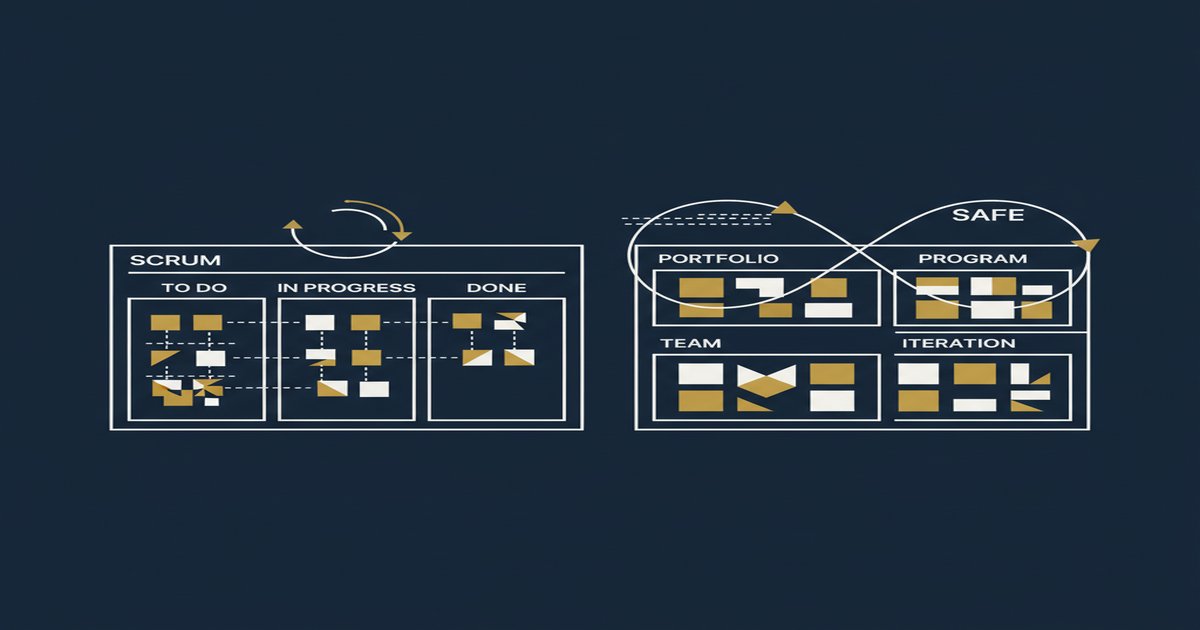
In 2026, the choice between SAFe and Scrum hinges on scale. Scrum excels for single, co-located teams of 3-9 members working on one product. SAFe is designed for enterprise-level complexity, coordinating multiple teams (50-125+ people) and is essential for large-scale programs, with SAFe-certified professionals often earning a 15-25% salary premium in enterprise roles.
Save 15% on any Instructor-Led Live Online Training course, worldwide, with code HOLIDAYS15. Valid until 31 December 2026, 11:59 pm Pacific Time. See courses and savings
Introduction: The Enduring Debate of Agile Scale
As we navigate 2026, the discussion around Agile methodologies has matured from a simple question of adoption to a more nuanced debate about application and scale. Two frameworks stand at the center of this conversation: Scrum and the Scaled Agile Framework (SAFe). For years, teams have asked which is 'better,' but this question misses the point. The correct question is: Which framework is the right tool for our specific context? The answer depends entirely on the size of your initiative, the complexity of your product, and the structure of your organization.
Scrum remains the undisputed champion for single-team agility. It provides a lightweight yet powerful set of rules and roles for delivering value iteratively. However, when an organization's ambition grows beyond a single product team and involves multiple teams building a complex, integrated solution, the coordination challenges often overwhelm Scrum's minimalist structure. This is the precise problem SAFe was engineered to solve. It provides the roles, ceremonies, and artifacts necessary to align dozens or even hundreds of practitioners toward a common goal.
This article offers a definitive 2026 guide to choosing between these frameworks. We will move beyond theoretical definitions to provide concrete data on salaries, certification costs, industry adoption, and real-world use cases drawn from our global cohorts at Learners Ink. We will dissect when Scrum is sufficient, when a move to SAFe is non-negotiable, and how a hybrid approach often provides a pragmatic path forward for organizations in transition. For the modern professional, understanding the strengths and limitations of both is no longer optional - it is a core competency.
SAFe vs Scrum: at-a-glance comparison
Team-level framework vs enterprise-scale operating model. Different jobs, not competitors.
| Dimension | Scrum | SAFe 6.0 |
|---|---|---|
| Scope | 1 team, 3 to 9 people | 50 to 125 people per ART, whole enterprise |
| Cadence | Sprint (1 to 4 weeks) | PI = 8 to 12 weeks + sprints |
| Key events | Sprint planning, review, retro | PI Planning, System Demo, Inspect & Adapt |
| Certifications | PSM, CSM (~$200 to $1,400) | SAFe SA, SPC, RTE (~$700 to $3,500) |
| Best for | Single product, startup, small teams | Regulated, multi-team, banks, telco, government |
What is Scrum? The Engine of Single-Team Agility
Scrum is an Agile framework designed for a single team to develop, deliver, and sustain complex products. Its foundation is empirical process control, meaning it relies on transparency, inspection, and adaptation. The framework operates on the principle that product development is an inherently complex challenge, and that a prescriptive, plan-driven approach is ill-suited to navigating its uncertainties. Instead, Scrum provides a lightweight structure of roles, events, and artifacts to help teams learn through experience and self-organize to solve problems.
The core unit in Scrum is the Scrum Team, a small, cross-functional group of typically 3 to 9 members. This team includes one Product Owner, who is responsible for maximizing the value of the product resulting from the team's work; one Scrum Master, who acts as a servant-leader and coach for the team; and the Developers, who are the skilled professionals doing the work of creating a usable increment each Sprint. There are no sub-teams or hierarchies within a Scrum Team; it is a cohesive unit focused on one product goal at a time.
The framework's cadence is driven by Sprints, which are fixed-length events of one month or less where a 'Done,' usable, and potentially releasable product Increment is created. Scrum prescribes five formal events to enable empiricism and structure the work:
- The Sprint: The container for all other events.
- Sprint Planning: Where the work for the upcoming Sprint is planned.
- Daily Scrum: A 15-minute event for the Developers to inspect progress and adapt the plan for the next 24 hours.
- Sprint Review: Where the Scrum Team and stakeholders inspect the Increment and adapt the Product Backlog.
- Sprint Retrospective: An opportunity for the Scrum Team to inspect itself and create a plan for improvements.
What is SAFe? Orchestrating Enterprise-Scale Delivery
The Scaled Agile Framework (SAFe) is a comprehensive body of knowledge that includes roles, responsibilities, practices, and a structured workflow for implementing Agile at enterprise scale. Where Scrum guides a single team, SAFe guides a network of teams. Created by Scaled Agile, Inc., it aims to address the significant challenges of aligning development, strategy, and execution in large organizations that must coordinate the work of hundreds, or even thousands, of people. As of 2026, SAFe 6.0 (with 7.0 on the horizon) has become the dominant framework for this purpose.
The primary organizational unit in SAFe is the Agile Release Train (ART). An ART is a long-lived, virtual organization of 50 to 125 people who plan, commit, and execute together. It is a team-of-teams that includes all the individuals needed to define, build, test, and release a solution. The ART's cadence is synchronized around a Program Increment (PI), which is a timebox (typically 8-12 weeks) that functions like a macro-sprint for the entire train. The capstone event is PI Planning, a multi-day, face-to-face (or virtual equivalent) event that serves as the heartbeat of the ART, aligning all teams on a shared mission and vision for the upcoming PI.
SAFe is not a one-size-fits-all framework. It offers four out-of-the-box configurations to meet the varying needs of different enterprises. This modularity allows an organization to adopt only what it needs:
- Essential SAFe: The most basic configuration, it describes the ART and the critical roles and events, including PI Planning.
- Large Solution SAFe: For organizations building very large and complex solutions that require multiple ARTs to collaborate, but without the need for portfolio-level considerations.
- Portfolio SAFe: Adds strategic alignment by connecting the enterprise strategy to portfolio execution through funding, governance, and Lean Portfolio Management.
- Full SAFe: The most comprehensive version, it integrates all levels of the framework, connecting the portfolio to large solutions and the individual ARTs.
Head-to-Head: When to Choose Scrum vs. SAFe
Choosing the right framework is a critical decision that directly impacts delivery effectiveness, team morale, and organizational overhead. The context of your product and team structure provides the clearest guidance. Scrum is the ideal, and often sufficient, choice when you are operating with a single, dedicated team working on one distinct product. If your organization has, for example, a 10-person team building a standalone mobile application, adopting the heavyweight structure of SAFe would be counterproductive. The ceremonies, roles, and artifacts of SAFe would introduce unnecessary complexity and slow the team down. Scrum provides everything needed for that team to focus on value delivery.
Conversely, SAFe becomes necessary when complexity and dependencies scale. Consider a scenario where an organization has 15 different teams working on a single, large-scale banking platform. These teams are not independent; the work of the 'mortgage application' team depends on the 'credit scoring' team, which in turn depends on the 'customer identity' team. Without a coordinating framework, these teams will devolve into chaos, with misaligned priorities, unmanaged dependencies, and duplicated effort. SAFe provides the structure - through ARTs and PI Planning - to untangle this web.
SAFe is also particularly valuable in highly regulated industries like finance, healthcare, and aerospace, or in complex hardware-software integrations like automotive systems. These domains require explicit governance, quality management, and compliance steps that are not native to Scrum but are built into the SAFe framework. If your solution requires a formal System Demo, integration with a complex supply chain, or auditable compliance checks, SAFe provides the guardrails that single-team Scrum simply does not.
The Critique of SAFe: Valid Concerns and Framework Evolution
No discussion of SAFe is complete without acknowledging the criticisms it faces, particularly from the Agile purist community. The primary critique is that SAFe is too prescriptive, too heavy, and too hierarchical. Critics argue that its detailed processes, numerous roles (Release Train Engineer, Solution Train Engineer), and extensive ceremonies represent a departure from the simplicity and empowerment at the heart of the original Agile Manifesto. Some have pejoratively labeled it 'Waterfall in Agile clothing' because of its emphasis on long-range planning (the PI) and its structured, top-down-influenced processes.
These criticisms have merit in certain contexts. A poorly implemented SAFe transformation, where the focus is on process compliance rather than on a Lean-Agile mindset, can indeed create a ceremony-heavy bureaucracy that stifles team autonomy. If PI Planning becomes a rigid, command-and-control exercise rather than a collaborative planning event, the framework fails to deliver on its promise. Our experience with Learners Ink cohorts shows that the success of a SAFe implementation is 90% dependent on the quality of its leadership and their commitment to servant leadership and decentralized decision-making.
However, Scaled Agile, Inc. has been responsive to these critiques. The evolution from version 5.0 to 6.0 and the emerging themes for 7.0 in 2026 demonstrate a clear trend toward simplification and flow. SAFe 6.0 introduced 'Flow Accelerators' and placed a stronger emphasis on Value Stream Management, shifting the focus from process adherence to the smooth delivery of value. The framework increasingly emphasizes that its configurations are a starting point, encouraging enterprises to adapt and evolve their implementation. While the purist critique remains, SAFe in 2026 is a more flexible and flow-oriented framework than its earlier iterations.
Certification, Cost, and Career: A 2026 Salary Analysis
For individual practitioners, the choice between a Scrum or SAFe certification track has significant career and financial implications. The Scrum certification landscape is dominated by two main bodies: Scrum.org (Professional Scrum) and the Scrum Alliance (Certified Scrum). Popular entry points include the Professional Scrum Master (PSM I) and Certified ScrumMaster (CSM). These certifications typically require 2 days of training (around 14-16 hours) and have an exam fee structure. As of 2026, a CSM course and certification costs between $1,000 and $1,500 USD, while the PSM I exam is a flat $200 USD, though the associated training is optional but recommended.
SAFe certifications are role-based and reflect the structure of the framework itself. The foundational certification is the Certified SAFe® Agilist (SA), which provides a broad overview. Other common certifications include the SAFe® Practitioner (SP) for team members, SAFe® Product Owner/Product Manager (POPM), and the advanced SAFe® Release Train Engineer (RTE) and SAFe® Program Consultant (SPC). These courses are also typically 2 days (16 hours), with costs ranging from $1,200 to $3,000 USD depending on the certification level. The RTE and SPC programs are more intensive and expensive, often exceeding $4,000 USD.
In 2026, our alumni data and broader market analysis show a clear salary premium for SAFe-certified professionals in enterprise environments. A Scrum Master with a CSM or PSM holding a role in a large program might earn an annual salary of $115,000 USD. A SAFe® Scrum Master in the same program often earns closer to $130,000 USD. This 15-25% premium becomes even more pronounced in senior roles. A Release Train Engineer (RTE), a role unique to SAFe, commands salaries between $160,000 and $200,000+, significantly higher than a typical senior Scrum Master role. This premium reflects the increased scope of responsibility - coordinating an entire ART of 100+ people versus a single team of 9.
- **Scrum Master (CSM/PSM):** $110,000 - $135,000 USD
- **SAFe® Scrum Master (SSM):** $125,000 - $150,000 USD
- **Product Owner (CSPO/PSPO):** $120,000 - $145,000 USD
- **SAFe® Product Owner/Product Manager (POPM):** $135,000 - $160,000 USD
- **Release Train Engineer (RTE):** $160,000 - $200,000+ USD
Adoption Trends: Where the Fortune 500 and Global Firms Stand
By 2026, the adoption of Agile frameworks within large enterprises is no longer a question of 'if' but 'how.' Industry reports from sources like Deloitte, Accenture, and KPMG consistently highlight that over 90% of large organizations employ Agile practices, with a significant and growing portion of them using a scaled framework. While Scrum remains pervasive at the team level, SAFe has unequivocally become the dominant language of scaled Agile delivery in the Fortune 500 and across global system integrators.
Major corporations in every sector, including FedEx, American Express, Intel, Cisco, and Lockheed Martin, publicly cite their use of SAFe to manage complex product portfolios. Consulting and implementation giants like Accenture, Capgemini, and Infosys have built entire practice areas around SAFe, training tens of thousands of their consultants as SAFe Program Consultants (SPCs) to lead enterprise transformations. This widespread adoption by service providers acts as a massive accelerator, embedding SAFe as the de facto standard for large-scale, multi-team projects worldwide. The number of individuals who have attended a SAFe class globally has surpassed 1.5 million, a testament to its market penetration.
The trend is clear: organizations that begin with team-level Scrum often hit a wall of complexity as they grow. They find themselves 'inventing' coordination roles, planning events, and governance structures. Eventually, they realize they are creating a makeshift, less effective version of what SAFe already provides. Adopting SAFe gives these organizations a common vocabulary and a proven playbook, which is highly attractive to enterprise executives who require predictability, alignment, and measurable business outcomes from their technology investments.
The Hybrid Model: Using Scrum-at-Team, SAFe-at-Program
One of the most pragmatic and successful patterns we see among our alumni is not a binary choice between Scrum and SAFe, but a hybrid implementation. This model leverages the strengths of both frameworks at the appropriate level. In fact, SAFe is explicitly designed to accommodate this structure. The framework does not prescribe what process a team must use internally; it only requires that teams can predictably deliver high-quality, tested software every two weeks.
In this hybrid model, the individual Agile teams on the Agile Release Train (ART) operate using Scrum. They have a Product Owner, a Scrum Master, and Developers. They run two-week Sprints, conduct their Daily Scrums, Sprint Reviews, and Retrospectives as usual. For the team members, their day-to-day experience is pure Scrum. This preserves the simplicity, focus, and empowerment that makes Scrum so effective for a small, collaborative unit.
However, these Scrum teams operate within the larger SAFe container at the program level. The team's Product Owner is a member of the ART's Product Management team, participating in backlog refinement and PI Planning. The Scrum Master works with other Scrum Masters and the Release Train Engineer (RTE) to resolve impediments and improve the flow of value across the ART. Every 8 to 12 weeks, the entire team participates in PI Planning, gaining an understanding of the larger business context and collaboratively planning their work for the upcoming Program Increment. This 'Scrum-and-SAFe' approach provides the best of both worlds: team-level agility and autonomy combined with program-level alignment and synchronization.
Talk to a senior counsellor about cohorts, instalments and a plan tailored to your background and timeline.
Frequently asked questions
Is SAFe still relevant in 2026?
Absolutely. In 2026, SAFe is more relevant than ever for large enterprises. While newer, lightweight scaling methods exist, SAFe's comprehensive, role-based structure is deeply embedded in Fortune 500 companies and government agencies. Its continued evolution with versions 6.0 and beyond, focusing on flow and Value Stream Management, ensures it addresses modern enterprise challenges, making it the dominant framework for complex, multi-team product development.
Why do some Agile practitioners 'hate' SAFe?
The criticism of SAFe stems from its perceived complexity and prescriptive nature, which some Agile purists feel contradicts the simplicity of the Agile Manifesto. They argue its numerous roles, events, and artifacts can lead to a 'heavy' process that mimics traditional waterfall project management if implemented poorly. However, many of these critiques are aimed at early versions or flawed implementations, not the more flexible, flow-focused framework SAFe has become.
Do I need a Scrum certification (like CSM) before taking a SAFe course?
It is not a formal prerequisite, but it is highly recommended. SAFe is built on a foundation of Agile and Scrum principles, and the framework assumes teams operate with this knowledge. Coming into a SAFe course, like the Certified SAFe® Agilist (SA), with a CSM or PSM certification provides essential context and makes the scaling concepts much easier to grasp. Our data shows that learners with prior Scrum knowledge have a significantly higher success rate and understanding of the SAFe material.
Which pays more in 2026: a Scrum or SAFe certification?
SAFe certifications consistently lead to higher salaries in enterprise roles. While a Scrum Master with a CSM can earn a strong salary around $115,000 USD, a SAFe-certified professional in a comparable large-scale program often earns 15-25% more. Specialized SAFe roles like the Release Train Engineer (RTE) command salaries upwards of $160,000-$200,000+, as they are responsible for program-level execution involving hundreds of people.
For a large organization, is SAFe the only choice?
While SAFe is the most popular and comprehensive framework for large organizations, it is not the only choice. Frameworks like LeSS (Large-Scale Scrum) and Scrum@Scale offer alternative, often more lightweight, approaches to scaling. However, SAFe's structured nature, clear roles, and extensive knowledge base make it particularly appealing to enterprise leadership seeking a well-defined path for their Agile transformation, which is why it has achieved such dominant market adoption.
Is SAFe truly Agile or just 'Waterfall in disguise'?
SAFe is fundamentally an Agile framework built on Lean-Agile principles, but a poor implementation can make it feel like waterfall. Its Program Increment (PI) planning involves longer-range planning than a typical Scrum sprint, which some critics compare to a waterfall phase. However, the plan is adaptable, teams operate in iterative sprints within the PI, and the focus is on delivering working software and adapting to feedback. A successful SAFe implementation fosters agility at scale, it does not disguise a waterfall process.
Recommended courses
Hand picked for readers of this article.
Ready to make this credential yours?
Talk to a senior counsellor about cohorts, instalments and a study plan tailored to your background.
Continue reading
More in Agile & Scrum
Recommended blogs from the same category.
Scrum Master vs Product Owner in 2026: Which Career Path Pays Better and Suits You
In 2026 Product Owner roles pay 12 to 22 percent more than Scrum Master roles at every career stage globally, but Scrum Master roles are 1.6 times more numerous. Median PO base is USD 132K in the US and INR 22L in India. Median SM base is USD 112K in the US and INR 18L in India. PO career ceiling is Head of Product or CPO. SM career ceiling is Agile Coach, Head of Agility or Transformation Lead. PO suits people who love outcomes, customer discovery and prioritisation trade offs. SM suits people who love team dynamics, unblocking and coaching. Start with CSM or PSM 1 if drifting into SM, CSPO or PSPO 1 if drifting into PO. Career pivots between the two are common through year 5.
SAFe vs LeSS in 2026: Which Scaling Framework Fits Your Enterprise
SAFe (Scaled Agile Framework) is the market leader by adoption (roughly 32 percent of scaling enterprises in 2026) with a heavy prescriptive structure of ARTs, PI Planning, RTEs and portfolio Kanban. LeSS (Large Scale Scrum) holds around 7 percent adoption, keeps single team Scrum roles and adds minimal structure. SAFe is the pragmatic choice for regulated, project centric and PMO heavy enterprises. LeSS is the candid choice for genuinely product organised firms with strong Scrum maturity. SAFe SPC costs USD 3,995, LeSS Practitioner costs USD 1,800 to USD 2,400. Neither fixes broken culture, framework is 20 percent of a transformation, coaching and org design is 80 percent.
Scrum Master Career Path in 2026: From CSM to Enterprise Coach
The Scrum Master career path in 2026 runs Scrum Master to Senior SM to Agile Coach to Enterprise Agile Coach or Head of Agile. Median jump between rungs is 2 to 4 years. Entry SM salaries start at USD 78,000 US and INR 10 lakh India metros. Senior SM lands at USD 118,000 / INR 20 lakh with CSM plus PSM II or A-CSM. Agile Coach peaks at USD 155,000 / INR 32 lakh with CTC or ICE-AC. Enterprise Coach reaches USD 185,000+ / INR 45 lakh+. The candid rule: earn CSM in year 1, A-CSM or PSM II in year 3, coaching certification by year 5, or growth stalls at Senior SM.
PMI-ACP vs SAFe Agilist in 2026: Which Agile Certification for Which Career
PMI-ACP is the framework agnostic agile practitioner credential from PMI: 120 questions in 3 hours, USD 495 (member) or USD 435 (non member correction: member USD 435, non member USD 495), 21 contact hours required, 8 months of agile experience in the last 3 years. SAFe Agilist (SA) is the entry certification for the Scaled Agile Framework: 45 questions in 90 minutes, USD 995 course fee (exam included), no prerequisite. Take PMI-ACP if you coach teams across multiple frameworks or work in consulting. Take SAFe Agilist if your employer runs SAFe (which is the dominant enterprise scaling framework in 2026 with roughly 40 percent share). Neither is universally better; hiring signal is entirely employer specific.
Product Backlog vs Sprint Backlog in 2026: Ownership, Content and Common Mistakes
The Product Backlog is the single, ordered, evolving list of everything that might be worth doing to the product. The Product Owner owns it. The Sprint Backlog is the subset of Product Backlog items the Developers select for a single Sprint plus the plan for delivering them and the Sprint Goal. The Developers own it. In 2026 the most common failure pattern is a Product Backlog treated as a task list and a Sprint Backlog treated as a status report. Healthy teams refine the Product Backlog continuously, keep the top 10 to 15 items ready, and re-plan the Sprint Backlog daily as understanding improves.
Scrum Master vs Project Manager in 2026: Roles, Skills, Salary and Which Path to Choose
A Scrum Master is accountable for the effectiveness of one Scrum Team, coaches on Scrum, removes impediments and protects the Sprint. A Project Manager is accountable for delivering a defined outcome inside scope, schedule and cost across one or more teams, using predictive, agile or hybrid delivery. In 2026 both roles are healthy in the market but they optimise for different things. Scrum Masters carry CSM, PSM or SAFe SM credentials and earn USD 108,000 to 135,000 in the US. Project Managers carry PMP, PRINCE2 or PMI-ACP and earn USD 118,000 to 155,000. Pick Scrum Master if you love team coaching and delivery flow. Pick Project Manager if you love outcome accountability, stakeholder management and cross-team delivery.
Latest from the blog
The freshest posts published across every category.
PRINCE2 Foundation and Practitioner Classroom Training in Cambridge, UK: October to December 2026 Cohorts
Learners Ink offers PRINCE2 7 Foundation and Practitioner Certification Training in Cambridge, United Kingdom, through in-person Classroom and Instructor-Led Live Online Training. The combined programme covers 32 contact hours over four training days. UK Classroom fees are £2,599 early bird and £2,999 standard. The October Classroom intensive is scheduled for 27 to 30 October 2026, subject to the existing booking cutoff and availability; November and December offer weekday and weekend options. Review the current cohort table before buying. HOLIDAYS15 applies to Live Online only, never Classroom.
PMI-CPMAI Live Online Training USA 2026: USD 1,999 Early Bird With Exam Voucher, USD 1,699.15 With HOLIDAYS15
Every US PMI-CPMAI Live Online fee now includes the official PMI-CPMAI exam voucher and PMI's mandatory 21-hour self-paced Exam Prep Course with learning materials. The early bird fee is USD 1,999 with the exam voucher, and the standard fee is USD 2,199 with the exam voucher. Enter HOLIDAYS15 at checkout and the early bird comes to USD 1,699.15, still including the exam voucher, until 31 December 2026, 11:59pm Pacific Time. You get 24 contact hours of live, instructor-led training on the six-phase CPMAI methodology from anywhere in the United States, with no sales tax added. [See dates and book your seat](https://www.learnersink.com/project-management/pmi-cpmai-certification-training-online-training-new-york-ny-usa).
PMI-CPMAI Classroom Training USA 2026: USD 2,999 Early Bird With Exam Voucher Included
US PMI-CPMAI Classroom training is USD 2,999 early bird and USD 3,199 standard, and both fees include the official PMI-CPMAI exam voucher and PMI's mandatory 21-hour self-paced Exam Prep Course with learning materials. You get 24 contact hours face to face with a senior AI project trainer, working through the six CPMAI phases on real cases with peers from your city. No sales tax is added. HOLIDAYS15 does not apply to Classroom; if you want the holiday discount, Live Online is USD 1,699.15 with the voucher until 31 December 2026, 11:59pm Pacific Time. [See Classroom dates](https://www.learnersink.com/project-management/pmi-cpmai-certification-training-course-new-york-ny-usa).
Machine Learning Training USA 2026: Live Online USD 1,099, Classroom USD 1,999, HOLIDAYS15 for Live Online Only
Machine Learning Certification Training in the USA is USD 1,099 early bird for Live Online and USD 1,999 early bird for Classroom. Standard fees are USD 1,399 and USD 2,399. With HOLIDAYS15, Live Online drops to USD 934.15 until 31 December 2026, 11:59pm Pacific Time. You get 50 contact hours of hands-on, instructor-led training in Python, scikit-learn, supervised and unsupervised learning, model evaluation and an intro to deep learning, finished with a capstone project. [See Live Online dates](https://www.learnersink.com/data-ai/machine-learning-certification-training-online-training-new-york-ny-usa).
Project Management Techniques (PMT): Practical Course Guide, Syllabus and Booking
Project Management Techniques (PMT) is a practical Learners Ink workshop for people who need to plan, estimate, monitor and deliver projects more confidently. The programme lists 8 contact hours and covers charter and scope, estimation, critical path scheduling, earned value, risk, stakeholders, quality and agile or hybrid techniques. Choose instructor-led Classroom or Live Online training, check the current fee and dates for your location, and earn a Learners Ink Certificate of Completion after passing the assessment. This is skills training, not the PMP or PRINCE2 certification exam.
Free PMI-CPMAI Practice Test 2026: Full-Length 120 Question Mock Exam for Managing AI Projects
The free Learners Ink PMI-CPMAI practice test gives you 120 questions in 160 minutes, spread across Foundations and the six CPMAI phases, from business needs and data preparation to testing and operationalization. It is tool agnostic, so it checks how you run an AI project, not which software you know. Download it from the [free PMI-CPMAI practice test page](https://www.learnersink.com/resources/practice-test/pmi-cpmai) and email your answers for a free score report.
Search the blog
Full search and filters: category, year, month, exact date, course, topic, hashtag and long-form.
PRINCE2 Foundation and Practitioner Classroom Training in Cambridge, UK: October to December 2026 Cohorts
Learners Ink offers PRINCE2 7 Foundation and Practitioner Certification Training in Cambridge, United Kingdom, through in-person Classroom and Instructor-Led Live Online Training. The combined programme covers 32 contact hours over four training days. UK Classroom fees are £2,599 early bird and £2,999 standard. The October Classroom intensive is scheduled for 27 to 30 October 2026, subject to the existing booking cutoff and availability; November and December offer weekday and weekend options. Review the current cohort table before buying. HOLIDAYS15 applies to Live Online only, never Classroom.
PMI-CPMAI Live Online Training USA 2026: USD 1,999 Early Bird With Exam Voucher, USD 1,699.15 With HOLIDAYS15
Every US PMI-CPMAI Live Online fee now includes the official PMI-CPMAI exam voucher and PMI's mandatory 21-hour self-paced Exam Prep Course with learning materials. The early bird fee is USD 1,999 with the exam voucher, and the standard fee is USD 2,199 with the exam voucher. Enter HOLIDAYS15 at checkout and the early bird comes to USD 1,699.15, still including the exam voucher, until 31 December 2026, 11:59pm Pacific Time. You get 24 contact hours of live, instructor-led training on the six-phase CPMAI methodology from anywhere in the United States, with no sales tax added. [See dates and book your seat](https://www.learnersink.com/project-management/pmi-cpmai-certification-training-online-training-new-york-ny-usa).
PMI-CPMAI Classroom Training USA 2026: USD 2,999 Early Bird With Exam Voucher Included
US PMI-CPMAI Classroom training is USD 2,999 early bird and USD 3,199 standard, and both fees include the official PMI-CPMAI exam voucher and PMI's mandatory 21-hour self-paced Exam Prep Course with learning materials. You get 24 contact hours face to face with a senior AI project trainer, working through the six CPMAI phases on real cases with peers from your city. No sales tax is added. HOLIDAYS15 does not apply to Classroom; if you want the holiday discount, Live Online is USD 1,699.15 with the voucher until 31 December 2026, 11:59pm Pacific Time. [See Classroom dates](https://www.learnersink.com/project-management/pmi-cpmai-certification-training-course-new-york-ny-usa).
Machine Learning Training USA 2026: Live Online USD 1,099, Classroom USD 1,999, HOLIDAYS15 for Live Online Only
Machine Learning Certification Training in the USA is USD 1,099 early bird for Live Online and USD 1,999 early bird for Classroom. Standard fees are USD 1,399 and USD 2,399. With HOLIDAYS15, Live Online drops to USD 934.15 until 31 December 2026, 11:59pm Pacific Time. You get 50 contact hours of hands-on, instructor-led training in Python, scikit-learn, supervised and unsupervised learning, model evaluation and an intro to deep learning, finished with a capstone project. [See Live Online dates](https://www.learnersink.com/data-ai/machine-learning-certification-training-online-training-new-york-ny-usa).
Project Management Techniques (PMT): Practical Course Guide, Syllabus and Booking
Project Management Techniques (PMT) is a practical Learners Ink workshop for people who need to plan, estimate, monitor and deliver projects more confidently. The programme lists 8 contact hours and covers charter and scope, estimation, critical path scheduling, earned value, risk, stakeholders, quality and agile or hybrid techniques. Choose instructor-led Classroom or Live Online training, check the current fee and dates for your location, and earn a Learners Ink Certificate of Completion after passing the assessment. This is skills training, not the PMP or PRINCE2 certification exam.
Free PMI-CPMAI Practice Test 2026: Full-Length 120 Question Mock Exam for Managing AI Projects
The free Learners Ink PMI-CPMAI practice test gives you 120 questions in 160 minutes, spread across Foundations and the six CPMAI phases, from business needs and data preparation to testing and operationalization. It is tool agnostic, so it checks how you run an AI project, not which software you know. Download it from the [free PMI-CPMAI practice test page](https://www.learnersink.com/resources/practice-test/pmi-cpmai) and email your answers for a free score report.

Holiday Season Guide
Celebrate with 15% off
Instructor-Led Live Online Training Courses Only
HOLIDAYS15
Worldwide, until 31 December 2026, 11:59 pm Pacific Time
Read the holiday guideFree PgMP Practice Test 2026: Full-Length 170 Question Mock Exam Download, Domains, Timing and How to Use It
The free Learners Ink PgMP practice test is a full-length paper: 170 questions in 240 minutes, weighted across the five PMI domains, with Program Life Cycle Management carrying 44% of the marks. It is written as program level scenarios, so you practise thinking about benefits, governance and many projects at once rather than a single project plan. Download it from the [free PgMP practice test page](https://www.learnersink.com/resources/practice-test/pgmp), sit it in one block, and email your answers for a free score report.
ITIL, MSP and M_o_R E-Learning in 2026: The Complete PeopleCert Course and Free Practice Test Guide
Learners Ink has 33 PeopleCert-accredited self-paced ITIL, MSP and M_o_R courses, with individual purchase pages, 365 days of access, and language editions offered according to country. Every module has a relevant free practice paper except the combined MSP learning option, which uses separate Foundation and Practitioner papers. Download a paper through its free request page, compare the courses below, then buy the appropriate self-paced option at the price shown for your country. The [complete catalogue](https://www.learnersink.com/itil-elearning-courses), [free resources](https://www.learnersink.com/resources) and [course enquiry form](https://www.learnersink.com/enquiry) are available without a classroom booking.
ITIL Self-Paced E-Learning in 2026: Complete Guide to All 33 Accredited ITIL, MSP and M_o_R Courses
Learners Ink, a PeopleCert Accredited Training Organisation (ATO ID 8297), sells 33 self-paced ITIL, MSP and M_o_R e-learning courses: 16 ITIL 4 Practitioner modules, the ITIL 4 Specialist, Strategist and Leader modules, six ITIL Version 5 courses, three MSP 5th Edition options and M_o_R 4 Practitioner. Every course is bought online, starts the same day, includes official courseware, practice questions with rationale and tutor support, and gives 365 days of access. Prices are shown in your local currency, 29 courses have a free full-length practice test, and courses are taught in 12 languages. Start at the [ITIL e-learning catalogue](https://www.learnersink.com/itil-elearning-courses).
PRINCE2 Certification Training in Canada: Classroom and Live Online Guide 2026
PRINCE2 training in Canada is available through Classroom and instructor-led Live Online formats. Compare eligibility, format, city availability and the current CAD fee on the relevant course page before booking.
PRINCE2 Certification Training in Australia: Classroom and Live Online Guide 2026
PRINCE2 training in Australia is available through Classroom and instructor-led Live Online formats. Compare eligibility, format, city availability and the current AUD fee on the relevant course page before booking.
PRINCE2 Certification Training in Belgium: Classroom and Live Online Guide 2026
PRINCE2 training in Belgium is available through Classroom and instructor-led Live Online formats. Compare eligibility, format, city availability and the current EUR fee on the relevant course page before booking.
PRINCE2 Certification Training in Ireland: Classroom and Live Online Guide 2026
PRINCE2 training in Ireland is available through Classroom and instructor-led Live Online formats. Compare eligibility, format, city availability and the current EUR fee on the relevant course page before booking.
PMP Certification Training in Canada: Classroom and Live Online Guide 2026
PMP training in Canada is available through Classroom and instructor-led Live Online formats. Compare eligibility, format, city availability and the current CAD fee on the relevant course page before booking.
PMP Certification Training in Australia: Classroom and Live Online Guide 2026
PMP training in Australia is available through Classroom and instructor-led Live Online formats. Compare eligibility, format, city availability and the current AUD fee on the relevant course page before booking.
PMP Certification Training in Belgium: Classroom and Live Online Guide 2026
PMP training in Belgium is available through Classroom and instructor-led Live Online formats. Compare eligibility, format, city availability and the current EUR fee on the relevant course page before booking.
PMP Certification Training in Ireland: Classroom and Live Online Guide 2026
PMP training in Ireland is available through Classroom and instructor-led Live Online formats. Compare eligibility, format, city availability and the current EUR fee on the relevant course page before booking.
ITIL Self-Paced Online E-Learning Courses in 2026: 33 Accredited Courses Taught in 12 Languages of Instruction
Learners Ink publishes 33 accredited self-paced ITIL, MSP and M_o_R e-learning courses, and they are taught in twelve languages of instruction, not only English. German, French, Spanish, Portuguese, Italian, Dutch, Danish, Norwegian, Polish, Japanese and Chinese editions are live alongside English, and the country catalogue shows the languages offered where you are. Every course carries official PeopleCert courseware, practice questions with rationale, tutor support, 365 days of access and an exam voucher option, priced in your own currency. Start at the [self-paced ITIL e-learning catalogue](https://www.learnersink.com/itil-elearning-courses).
Corporate Training in 2026: The Complete Guide for CXOs, HR and L&D Leaders
Corporate training in 2026 works best as a three mode blend: instructor-led live online for the core cohort (lowest cost per learner, no travel, learners from every office in one room), on-site classroom at your own premises for leadership and intact delivery teams, and self-paced e-learning in 12 languages of instruction for scale and for refreshers. Budget the fully loaded cost, not the invoice: add salary hours, travel and productivity drag. Live online typically lands 35 to 55 percent below on-site for the same certification because travel, venue and downtime disappear. Measure at Kirkpatrick levels 3 and 4, gate the programme on a benefit cost ratio above 1.5, and start every rollout with a free full length practice test so you baseline capability before you spend.
Free ITIL 4 Specialist: Plan, Implement and Control Practice Test for Download: Full Length 60 Question Mock Exam for 2026
ITIL 4 Specialist: Plan, Implement and Control is a 60 question paper sat over 90 minutes with a pass mark of 65% (39 / 60), and the self-paced e-learning route gives you the syllabus without ever testing it under a clock. The Learners Ink free ITIL 4 Specialist: Plan, Implement and Control practice test closes that gap: a full length weighted paper that mirrors the live exam pattern question for question. The download is free, no payment at any stage. When you have sat it, email your answers to info@learnersink.com and a certified trainer sends the complete answer key with a written rationale for every question, plus a free personalised score report that breaks your result down syllabus area by syllabus area so you know exactly what to revise.
Free ITIL 4 Leader: Digital and IT Strategy Practice Test for Download: Full Length 30 Question Mock Exam for 2026
ITIL 4 Leader: Digital and IT Strategy is a 30 question paper sat over 60 minutes with a pass mark of 70% (21 / 30), and the self-paced e-learning route gives you the syllabus without ever testing it under a clock. The Learners Ink free ITIL 4 Leader: Digital and IT Strategy practice test closes that gap: a full length weighted paper that mirrors the live exam pattern question for question. The download is free, no payment at any stage. When you have sat it, email your answers to info@learnersink.com and a certified trainer sends the complete answer key with a written rationale for every question, plus a free personalised score report that breaks your result down syllabus area by syllabus area so you know exactly what to revise.
Free ITIL 4 Specialist: Create, Deliver and Support Practice Test for Download: Full Length 40 Question Mock Exam for 2026
ITIL 4 Specialist: Create, Deliver and Support is a 40 question paper sat over 90 minutes with a pass mark of 70% (28 / 40), and the self-paced e-learning route gives you the syllabus without ever testing it under a clock. The Learners Ink free ITIL 4 Specialist: Create, Deliver and Support practice test closes that gap: a full length weighted paper that mirrors the live exam pattern question for question. The download is free, no payment at any stage. When you have sat it, email your answers to info@learnersink.com and a certified trainer sends the complete answer key with a written rationale for every question, plus a free personalised score report that breaks your result down syllabus area by syllabus area so you know exactly what to revise.
Free ITIL 4 Specialist: Drive Stakeholder Value Practice Test for Download: Full Length 40 Question Mock Exam for 2026
ITIL 4 Specialist: Drive Stakeholder Value is a 40 question paper sat over 90 minutes with a pass mark of 70% (28 / 40), and the self-paced e-learning route gives you the syllabus without ever testing it under a clock. The Learners Ink free ITIL 4 Specialist: Drive Stakeholder Value practice test closes that gap: a full length weighted paper that mirrors the live exam pattern question for question. The download is free, no payment at any stage. When you have sat it, email your answers to info@learnersink.com and a certified trainer sends the complete answer key with a written rationale for every question, plus a free personalised score report that breaks your result down syllabus area by syllabus area so you know exactly what to revise.
Free ITIL 4 Specialist: High-Velocity IT Practice Test for Download: Full Length 40 Question Mock Exam for 2026
ITIL 4 Specialist: High-Velocity IT is a 40 question paper sat over 90 minutes with a pass mark of 70% (28 / 40), and the self-paced e-learning route gives you the syllabus without ever testing it under a clock. The Learners Ink free ITIL 4 Specialist: High-Velocity IT practice test closes that gap: a full length weighted paper that mirrors the live exam pattern question for question. The download is free, no payment at any stage. When you have sat it, email your answers to info@learnersink.com and a certified trainer sends the complete answer key with a written rationale for every question, plus a free personalised score report that breaks your result down syllabus area by syllabus area so you know exactly what to revise.
Free ITIL 4 Strategist: Direct, Plan and Improve Practice Test for Download: Full Length 40 Question Mock Exam for 2026
ITIL 4 Strategist: Direct, Plan and Improve is a 40 question paper sat over 90 minutes with a pass mark of 70% (28 / 40), and the self-paced e-learning route gives you the syllabus without ever testing it under a clock. The Learners Ink free ITIL 4 Strategist: Direct, Plan and Improve practice test closes that gap: a full length weighted paper that mirrors the live exam pattern question for question. The download is free, no payment at any stage. When you have sat it, email your answers to info@learnersink.com and a certified trainer sends the complete answer key with a written rationale for every question, plus a free personalised score report that breaks your result down syllabus area by syllabus area so you know exactly what to revise.
Free ITIL Experience (Version 5) Practice Test for Download: Full Length 40 Question Mock Exam for 2026
ITIL Experience (Version 5) is a 40 question paper sat over 90 minutes with a pass mark of 70% (28 / 40), and the self-paced e-learning route gives you the syllabus without ever testing it under a clock. The Learners Ink free ITIL Experience (Version 5) practice test closes that gap: a full length weighted paper that mirrors the live exam pattern question for question. The download is free, no payment at any stage. When you have sat it, email your answers to info@learnersink.com and a certified trainer sends the complete answer key with a written rationale for every question, plus a free personalised score report that breaks your result down syllabus area by syllabus area so you know exactly what to revise.
Free ITIL Foundation Bridge (Version 5) Practice Test for Download: Full Length 20 Question Mock Exam for 2026
ITIL Foundation Bridge (Version 5) is a 20 question paper sat over 30 minutes with a pass mark of 65% (13 / 20), and the self-paced e-learning route gives you the syllabus without ever testing it under a clock. The Learners Ink free ITIL Foundation Bridge (Version 5) practice test closes that gap: a full length weighted paper that mirrors the live exam pattern question for question. The download is free, no payment at any stage. When you have sat it, email your answers to info@learnersink.com and a certified trainer sends the complete answer key with a written rationale for every question, plus a free personalised score report that breaks your result down syllabus area by syllabus area so you know exactly what to revise.
Free ITIL Product (Version 5) Practice Test for Download: Full Length 40 Question Mock Exam for 2026
ITIL Product (Version 5) is a 40 question paper sat over 90 minutes with a pass mark of 70% (28 / 40), and the self-paced e-learning route gives you the syllabus without ever testing it under a clock. The Learners Ink free ITIL Product (Version 5) practice test closes that gap: a full length weighted paper that mirrors the live exam pattern question for question. The download is free, no payment at any stage. When you have sat it, email your answers to info@learnersink.com and a certified trainer sends the complete answer key with a written rationale for every question, plus a free personalised score report that breaks your result down syllabus area by syllabus area so you know exactly what to revise.
Free ITIL Service (Version 5) Practice Test for Download: Full Length 40 Question Mock Exam for 2026
ITIL Service (Version 5) is a 40 question paper sat over 90 minutes with a pass mark of 70% (28 / 40), and the self-paced e-learning route gives you the syllabus without ever testing it under a clock. The Learners Ink free ITIL Service (Version 5) practice test closes that gap: a full length weighted paper that mirrors the live exam pattern question for question. The download is free, no payment at any stage. When you have sat it, email your answers to info@learnersink.com and a certified trainer sends the complete answer key with a written rationale for every question, plus a free personalised score report that breaks your result down syllabus area by syllabus area so you know exactly what to revise.