
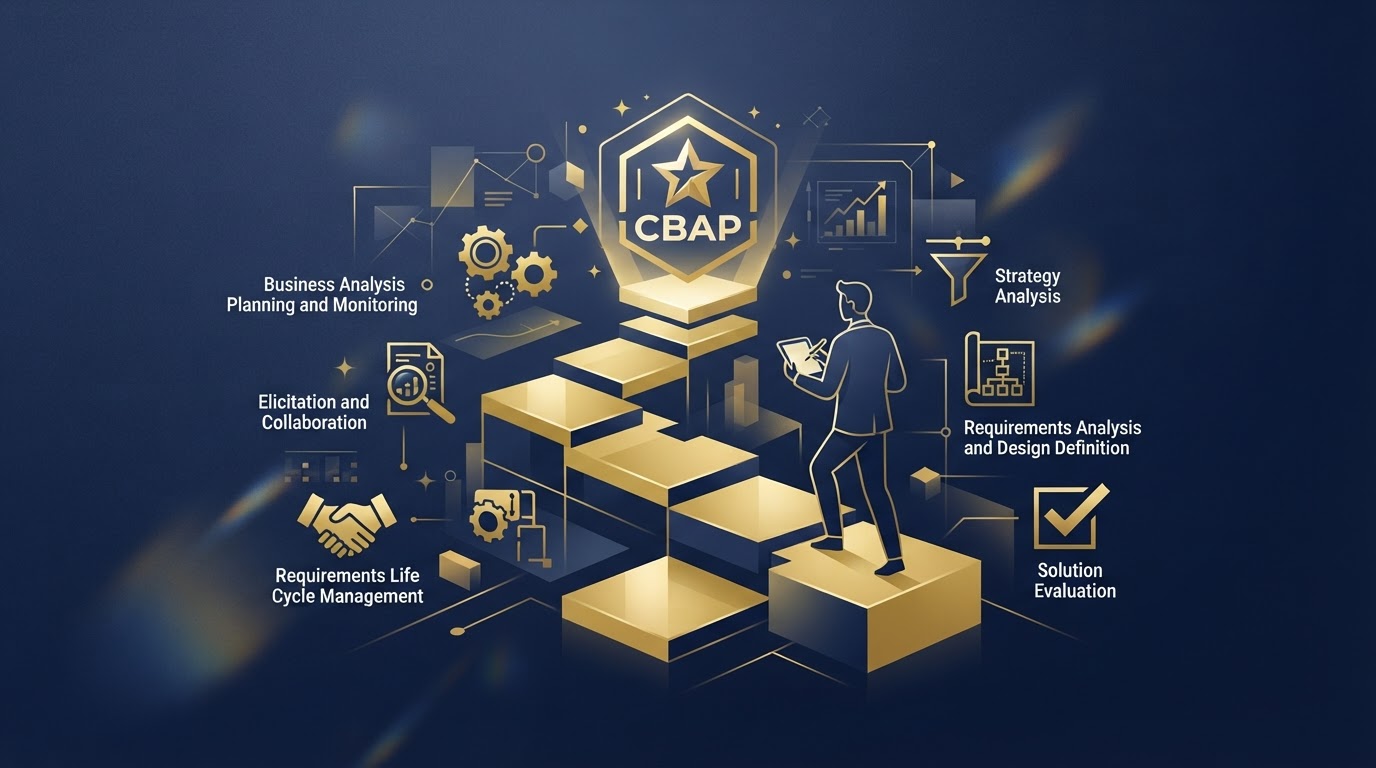
The CBAP exam has 120 case-based questions in 3.5 hours and rewards deep BABOK v3 pattern recognition, not memorisation. A 12-week plan with 8 to 10 focused hours per week is the sweet spot for working BAs: 4 weeks reading and mapping techniques, 4 weeks technique drills and knowledge area quizzes, 4 weeks full length simulators. Book the exam in week 6 to lock a deadline. IIBA reported 71 percent first attempt pass in 2026 for candidates who completed 3 or more full length simulators.
Save 15% on any Instructor-Led Live Online Training course, worldwide, with code HOLIDAYS15. Valid until 31 December 2026, 11:59 pm Pacific Time. See courses and savings
What the CBAP exam actually tests in 2026
The CBAP exam is 120 scenario-based questions delivered in 3.5 hours, scored pass or fail against a scaled 500 point line (roughly 70 percent correct on the raw items). Every question is a mini case: two to four sentences describing a project situation followed by four options, three of which are plausible. Rote knowledge of definitions will not carry you. The examiners want to see that you can identify which BABOK technique fits a situation, what the correct next task is inside a knowledge area, and how to spot when a stakeholder input is incomplete.
The blueprint remains anchored to BABOK Guide v3 with weightings dominated by Elicitation and Collaboration (20 percent), Requirements Analysis and Design Definition (30 percent), Strategy Analysis (15 percent) and Requirements Life Cycle Management (15 percent). Business Analysis Planning and Monitoring and Solution Evaluation share the remaining 20 percent. Underlying competencies and techniques are woven across every question, so treat the technique appendix as core material, not reference.
CBAP 12-week plan: at-a-glance
Time allocation matched to BABOK v3 knowledge-area weightings.
| Weeks | BABOK focus | Hours / week | Mock target |
|---|---|---|---|
| 1 to 3 | BA Planning + Elicitation | 8 to 10 | KA quiz 70%+ |
| 4 to 6 | Requirements Life Cycle + Strategy Analysis | 10 | Mock 1 full length |
| 7 to 9 | Requirements Analysis + Solution Evaluation | 10 to 12 | Mock 2 + weak-area drill |
| 10 to 12 | Techniques + full-length mocks | 12 | 3 mocks at 75%+ |
The 12 week plan at a glance
This cadence assumes 8 to 10 hours per week and one full weekend day for a practice test in the back half. Adjust proportionally if you can commit more, but do not compress reading below 4 weeks - the tasks and techniques take repeated exposure to stick.
- Weeks 1 to 2: Read BABOK chapters 1 to 3 (Introduction, Key Concepts, BA Planning and Monitoring). Build a one page mind map of the six knowledge areas and 30 tasks.
- Weeks 3 to 4: Chapters 4 to 5 (Elicitation and Collaboration, RLCM). Draft your CBAP application in parallel - 7,500 hours across 4 of 6 knowledge areas is the eligibility bar.
- Weeks 5 to 6: Chapters 6 to 7 (Strategy Analysis, RADD). Book the exam at end of week 6. This creates a hard deadline that doubles study focus.
- Weeks 7 to 8: Chapter 8 (Solution Evaluation) and chapter 10 (Techniques). Do 20 technique flashcards per day using the 50 most-tested techniques.
- Weeks 9 to 10: Two full length 120 question simulators. Debrief every wrong answer against the BABOK task or technique that owns it.
- Weeks 11 to 12: Two more simulators, one weakness targeted quiz per day. Final week: light review, no new material.
How to memorise the 50 techniques without burning out
BABOK lists 50 techniques in chapter 10 and CBAP items lean on roughly 30 of them heavily. The trap is trying to memorise all 50 at equal depth. Instead, build a matrix mapping each technique to the tasks that use it (BABOK already provides this at the bottom of each task description). When you can answer without looking, you have internalised the pattern the exam actually tests.
For each technique, capture four bullets: what it is in one sentence, when to use it, when NOT to use it, and one common exam distractor (e.g. Brainstorming is often confused with Focus Groups - Brainstorming generates ideas divergently, Focus Groups explore attitudes convergently).
The application: 7,500 hours and how to defend it
IIBA requires 7,500 hours of BA experience in the last 10 years, with at least 900 hours in 4 of the 6 knowledge areas, plus 35 hours of professional development and two references. Audit rate hovers around 15 percent, so document as if you will be audited.
Log hours in a spreadsheet by project, month and knowledge area. Do not round every project to 900 hours in every area - reviewers spot templated inflation. Ask references early; senior sponsors can take weeks to respond.
Exam day tactics that add 5 to 8 percent
3.5 hours for 120 questions is 105 seconds per question. Use a two pass strategy: first pass at 90 seconds each, flag anything that takes longer. That leaves 30 minutes of buffer for flagged items. Do not agonise on question 1; the score is aggregate.
When two options look right, ask which one the BABOK task description would say to do FIRST or NEXT. CBAP heavily favours process ordering. Reject options that skip a required input or produce an output before its dependency exists.
Common failure modes and how to avoid them
The top three reasons candidates fail on first attempt: reading BABOK once without mapping techniques to tasks, skipping full length simulators (doing only 20 question quizzes), and misreading scenarios by not noting the stated project methodology (agile, plan-driven, hybrid) which changes the correct answer.

Talk to a senior counsellor about cohorts, instalments and a plan tailored to your background and timeline.
Frequently asked questions
How hard is CBAP compared to PMI-PBA?
CBAP is generally rated harder because it demands deeper BABOK pattern recognition and the scenarios are longer. PMI-PBA is broader but shallower. Senior BAs with 5+ years experience prefer CBAP; PMs pivoting into BA work often prefer PMI-PBA first.
Can I pass CBAP in 8 weeks?
Possible if you have 5+ years hands-on BA experience and can commit 15+ hours per week. For most working professionals, 12 weeks is safer and matches published pass rate data.
Do I need a training provider for the 35 PD hours?
You can accumulate PD hours from IIBA endorsed education providers, chapter events or self directed study up to a cap. An accredited CBAP prep course covers all 35 hours in one go and includes practice tests.
What is the CBAP passing score?
IIBA does not publish a raw percentage but the community consensus based on scaled scoring is around 70 percent correct. Aim for 80 percent on your final simulators to build a safety margin.
Recommended courses
Hand picked for readers of this article.
Ready to make this credential yours?
Talk to a senior counsellor about cohorts, instalments and a study plan tailored to your background.
Continue reading
More in Business Analysis
Recommended blogs from the same category.
Business Analyst Career Path in 2026: The Candid Roadmap
The 2026 business analyst path has five stops: junior BA (0 to 2 years), BA (2 to 5), senior BA (5 to 8), lead BA or product owner (8 to 12), and BA practice lead or head of product (12+). Certifications map roughly to stops: ECBA at junior, CCBA at BA, CBAP or PMI-PBA at senior, PSPO or CSPO for the product owner branch, and a Masters or industry credential at practice lead. Median base pay progression in 2026: USD 62k to 155k in US, INR 6 to 42 LPA in India. The biggest career fork is at year 5 to 8: stay in delivery BA, or branch into product ownership.
CBAP vs PMI-PBA in 2026: Which Business Analysis Credential Fits You
CBAP from IIBA is the global gold standard for pure business analysis careers in 2026 and appears in roughly 68 percent of senior BA job postings. PMI-PBA is the right pick when BA work sits inside project or programme delivery, with 24 percent share and growing in PMO led shops. CBAP costs USD 505 (member) with 7,500 hours BA experience required. PMI-PBA costs USD 405 (member) with 4,500 to 7,500 hours. Prep is 12 to 16 weeks for CBAP, 10 to 14 weeks for PMI-PBA. Salary uplift is 24 to 32 percent. Take CBAP if you plan a lifelong BA specialist career. Take PMI-PBA if you already hold PMP or work inside a PMO led delivery shop.
CBAP vs PMI-PBA in 2026: Which Business Analysis Credential Actually Fits Your Career
CBAP from IIBA is the global gold standard for pure business analysis roles in 2026, with roughly 68 percent of senior BA postings mentioning it. PMI-PBA is the choice when BA work sits inside project or programme management, with roughly 24 percent share but growing fast in PMO led shops. CBAP costs USD 505 (member) with 7,500 hours BA experience required. PMI-PBA costs USD 405 (member) with 4,500 to 7,500 hours depending on degree. Prep is 12 to 16 weeks for CBAP, 10 to 14 weeks for PMI-PBA. Salary uplift is 24 to 32 percent globally. Take CBAP if you want a lifelong BA specialist career. Take PMI-PBA if you already hold PMP or work in a PMO led project delivery shop.
CBAP vs CCBA vs ECBA in 2026: Which IIBA Certification Fits Your Stage
IIBA offers three career stage credentials. ECBA (Entry Certificate in Business Analysis) is for 0 to 2 year BAs with no work hours requirement. CCBA (Certification of Capability in Business Analysis) is for 2 to 5 year BAs requiring 3,750 hours of BA work. CBAP (Certified Business Analysis Professional) is the flagship for 5 plus year BAs requiring 7,500 hours. Choose ECBA at year 0 to 2, CCBA at year 3 to 5, CBAP at year 5 to 7 when you meet the hours. Salary uplift is 8 to 14 percent (ECBA), 12 to 20 percent (CCBA), 18 to 30 percent (CBAP). Do not skip CCBA if you are between the two hour bars, IIBA is strict on hours audits.
Business Analyst vs Product Owner in 2026: The Candid Comparison
Business Analyst and Product Owner overlap on requirements and stakeholder work but split on decision authority. The Business Analyst investigates, models and documents what the business needs across multiple initiatives. The Product Owner owns one product backlog, prioritises it and answers to a single value stream. In 2026 the Product Owner earns 8 to 18 percent more at the same experience band in the US and UK but the Business Analyst has a wider job market, longer tenure and easier lateral moves. Pick Product Owner if you want single product depth, decision authority and a Scrum team. Pick Business Analyst if you want cross programme breadth, analytical depth and lower on call load.
CBAP Certification Training: The Definitive 2026 Guide
The Certified Business Analysis Professional (CBAP) is the highest-tier certification for business analysts, signifying mastery of the BABOK Guide. CBAP holders in 2026 command an average salary premium of 26% over non-certified peers. Achieving this requires meeting strict experience criteria, passing a rigorous 3.5-hour exam, and adopting a structured study plan over 12-16 weeks.
Latest from the blog
The freshest posts published across every category.
PRINCE2 Foundation and Practitioner Live Online Training: UK, Europe, Canada, Australia, New Zealand and GCC, HOLIDAYS15 for Live Online Only
Choose PRINCE2 Foundation and Practitioner together to move from understanding the method to applying and tailoring it. Learners Ink provides 32 contact hours over four training days through Instructor-Led Live Online Training, also called Instructor-led Live Virtual Training or a Live Virtual Class. UK fees are GBP 1,399 early bird / GBP 1,799 standard; with HOLIDAYS15, pay GBP 1,189.15 / GBP 1,529.15. Eligible EUR-market fees are EUR 1,399 / EUR 1,799 with the same numerical discounted amounts in EUR. Canada, Australia, New Zealand and GCC fees are shown separately below. HOLIDAYS15 is Live Online only until 31 December 2026, 11:59pm Pacific Time, never Classroom or e-learning. Compare local fees, use the budget and study calculators, download free Foundation and Practitioner practice tests, then select a cohort to Buy Now or Enquire Now.
PRINCE2 Foundation and Practitioner Classroom Training in Cambridge, UK: October to December 2026 Cohorts
Learners Ink offers PRINCE2 7 Foundation and Practitioner Certification Training in Cambridge, United Kingdom, through in-person Classroom and Instructor-Led Live Online Training. The combined programme covers 32 contact hours over four training days. UK Classroom fees are £2,599 early bird and £2,999 standard. The October Classroom intensive is scheduled for 27 to 30 October 2026, subject to the existing booking cutoff and availability; November and December offer weekday and weekend options. Review the current cohort table before buying. HOLIDAYS15 applies to Live Online only, never Classroom.
PMI-CPMAI Live Online Training USA 2026: USD 1,999 Early Bird With Exam Voucher, USD 1,699.15 With HOLIDAYS15
Every US PMI-CPMAI Live Online fee now includes the official PMI-CPMAI exam voucher and PMI's mandatory 21-hour self-paced Exam Prep Course with learning materials. The early bird fee is USD 1,999 with the exam voucher, and the standard fee is USD 2,199 with the exam voucher. Enter HOLIDAYS15 at checkout and the early bird comes to USD 1,699.15, still including the exam voucher, until 31 December 2026, 11:59pm Pacific Time. You get 24 contact hours of live, instructor-led training on the six-phase CPMAI methodology from anywhere in the United States, with no sales tax added. [See dates and book your seat](https://www.learnersink.com/project-management/pmi-cpmai-certification-training-online-training-new-york-ny-usa).
PMI-CPMAI Classroom Training USA 2026: USD 2,999 Early Bird With Exam Voucher Included
US PMI-CPMAI Classroom training is USD 2,999 early bird and USD 3,199 standard, and both fees include the official PMI-CPMAI exam voucher and PMI's mandatory 21-hour self-paced Exam Prep Course with learning materials. You get 24 contact hours face to face with a senior AI project trainer, working through the six CPMAI phases on real cases with peers from your city. No sales tax is added. HOLIDAYS15 does not apply to Classroom; if you want the holiday discount, Live Online is USD 1,699.15 with the voucher until 31 December 2026, 11:59pm Pacific Time. [See Classroom dates](https://www.learnersink.com/project-management/pmi-cpmai-certification-training-course-new-york-ny-usa).
Machine Learning Training USA 2026: Live Online USD 1,099, Classroom USD 1,999, HOLIDAYS15 for Live Online Only
Machine Learning Certification Training in the USA is USD 1,099 early bird for Live Online and USD 1,999 early bird for Classroom. Standard fees are USD 1,399 and USD 2,399. With HOLIDAYS15, Live Online drops to USD 934.15 until 31 December 2026, 11:59pm Pacific Time. You get 50 contact hours of hands-on, instructor-led training in Python, scikit-learn, supervised and unsupervised learning, model evaluation and an intro to deep learning, finished with a capstone project. [See Live Online dates](https://www.learnersink.com/data-ai/machine-learning-certification-training-online-training-new-york-ny-usa).
Project Management Techniques (PMT): Practical Course Guide, Syllabus and Booking
Project Management Techniques (PMT) is a practical Learners Ink workshop for people who need to plan, estimate, monitor and deliver projects more confidently. The programme lists 8 contact hours and covers charter and scope, estimation, critical path scheduling, earned value, risk, stakeholders, quality and agile or hybrid techniques. Choose instructor-led Classroom or Live Online training, check the current fee and dates for your location, and earn a Learners Ink Certificate of Completion after passing the assessment. This is skills training, not the PMP or PRINCE2 certification exam.
Search the blog
Full search and filters: category, year, month, exact date, course, topic, hashtag and long-form.
PRINCE2 Foundation and Practitioner Live Online Training: UK, Europe, Canada, Australia, New Zealand and GCC, HOLIDAYS15 for Live Online Only
Choose PRINCE2 Foundation and Practitioner together to move from understanding the method to applying and tailoring it. Learners Ink provides 32 contact hours over four training days through Instructor-Led Live Online Training, also called Instructor-led Live Virtual Training or a Live Virtual Class. UK fees are GBP 1,399 early bird / GBP 1,799 standard; with HOLIDAYS15, pay GBP 1,189.15 / GBP 1,529.15. Eligible EUR-market fees are EUR 1,399 / EUR 1,799 with the same numerical discounted amounts in EUR. Canada, Australia, New Zealand and GCC fees are shown separately below. HOLIDAYS15 is Live Online only until 31 December 2026, 11:59pm Pacific Time, never Classroom or e-learning. Compare local fees, use the budget and study calculators, download free Foundation and Practitioner practice tests, then select a cohort to Buy Now or Enquire Now.
PRINCE2 Foundation and Practitioner Classroom Training in Cambridge, UK: October to December 2026 Cohorts
Learners Ink offers PRINCE2 7 Foundation and Practitioner Certification Training in Cambridge, United Kingdom, through in-person Classroom and Instructor-Led Live Online Training. The combined programme covers 32 contact hours over four training days. UK Classroom fees are £2,599 early bird and £2,999 standard. The October Classroom intensive is scheduled for 27 to 30 October 2026, subject to the existing booking cutoff and availability; November and December offer weekday and weekend options. Review the current cohort table before buying. HOLIDAYS15 applies to Live Online only, never Classroom.
PMI-CPMAI Live Online Training USA 2026: USD 1,999 Early Bird With Exam Voucher, USD 1,699.15 With HOLIDAYS15
Every US PMI-CPMAI Live Online fee now includes the official PMI-CPMAI exam voucher and PMI's mandatory 21-hour self-paced Exam Prep Course with learning materials. The early bird fee is USD 1,999 with the exam voucher, and the standard fee is USD 2,199 with the exam voucher. Enter HOLIDAYS15 at checkout and the early bird comes to USD 1,699.15, still including the exam voucher, until 31 December 2026, 11:59pm Pacific Time. You get 24 contact hours of live, instructor-led training on the six-phase CPMAI methodology from anywhere in the United States, with no sales tax added. [See dates and book your seat](https://www.learnersink.com/project-management/pmi-cpmai-certification-training-online-training-new-york-ny-usa).
PMI-CPMAI Classroom Training USA 2026: USD 2,999 Early Bird With Exam Voucher Included
US PMI-CPMAI Classroom training is USD 2,999 early bird and USD 3,199 standard, and both fees include the official PMI-CPMAI exam voucher and PMI's mandatory 21-hour self-paced Exam Prep Course with learning materials. You get 24 contact hours face to face with a senior AI project trainer, working through the six CPMAI phases on real cases with peers from your city. No sales tax is added. HOLIDAYS15 does not apply to Classroom; if you want the holiday discount, Live Online is USD 1,699.15 with the voucher until 31 December 2026, 11:59pm Pacific Time. [See Classroom dates](https://www.learnersink.com/project-management/pmi-cpmai-certification-training-course-new-york-ny-usa).
Machine Learning Training USA 2026: Live Online USD 1,099, Classroom USD 1,999, HOLIDAYS15 for Live Online Only
Machine Learning Certification Training in the USA is USD 1,099 early bird for Live Online and USD 1,999 early bird for Classroom. Standard fees are USD 1,399 and USD 2,399. With HOLIDAYS15, Live Online drops to USD 934.15 until 31 December 2026, 11:59pm Pacific Time. You get 50 contact hours of hands-on, instructor-led training in Python, scikit-learn, supervised and unsupervised learning, model evaluation and an intro to deep learning, finished with a capstone project. [See Live Online dates](https://www.learnersink.com/data-ai/machine-learning-certification-training-online-training-new-york-ny-usa).
Project Management Techniques (PMT): Practical Course Guide, Syllabus and Booking
Project Management Techniques (PMT) is a practical Learners Ink workshop for people who need to plan, estimate, monitor and deliver projects more confidently. The programme lists 8 contact hours and covers charter and scope, estimation, critical path scheduling, earned value, risk, stakeholders, quality and agile or hybrid techniques. Choose instructor-led Classroom or Live Online training, check the current fee and dates for your location, and earn a Learners Ink Certificate of Completion after passing the assessment. This is skills training, not the PMP or PRINCE2 certification exam.
Free PMI-CPMAI Practice Test 2026: Full-Length 120 Question Mock Exam for Managing AI Projects
The free Learners Ink PMI-CPMAI practice test gives you 120 questions in 160 minutes, spread across Foundations and the six CPMAI phases, from business needs and data preparation to testing and operationalization. It is tool agnostic, so it checks how you run an AI project, not which software you know. Download it from the [free PMI-CPMAI practice test page](https://www.learnersink.com/resources/practice-test/pmi-cpmai) and email your answers for a free score report.

Holiday Season Guide
Celebrate with 15% off
Instructor-Led Live Online Training Courses Only
HOLIDAYS15
Worldwide, until 31 December 2026, 11:59 pm Pacific Time
Read the holiday guideFree PgMP Practice Test 2026: Full-Length 170 Question Mock Exam Download, Domains, Timing and How to Use It
The free Learners Ink PgMP practice test is a full-length paper: 170 questions in 240 minutes, weighted across the five PMI domains, with Program Life Cycle Management carrying 44% of the marks. It is written as program level scenarios, so you practise thinking about benefits, governance and many projects at once rather than a single project plan. Download it from the [free PgMP practice test page](https://www.learnersink.com/resources/practice-test/pgmp), sit it in one block, and email your answers for a free score report.
ITIL, MSP and M_o_R E-Learning in 2026: The Complete PeopleCert Course and Free Practice Test Guide
Learners Ink has 33 PeopleCert-accredited self-paced ITIL, MSP and M_o_R courses, with individual purchase pages, 365 days of access, and language editions offered according to country. Every module has a relevant free practice paper except the combined MSP learning option, which uses separate Foundation and Practitioner papers. Download a paper through its free request page, compare the courses below, then buy the appropriate self-paced option at the price shown for your country. The [complete catalogue](https://www.learnersink.com/itil-elearning-courses), [free resources](https://www.learnersink.com/resources) and [course enquiry form](https://www.learnersink.com/enquiry) are available without a classroom booking.
ITIL Self-Paced E-Learning in 2026: Complete Guide to All 33 Accredited ITIL, MSP and M_o_R Courses
Learners Ink, a PeopleCert Accredited Training Organisation (ATO ID 8297), sells 33 self-paced ITIL, MSP and M_o_R e-learning courses: 16 ITIL 4 Practitioner modules, the ITIL 4 Specialist, Strategist and Leader modules, six ITIL Version 5 courses, three MSP 5th Edition options and M_o_R 4 Practitioner. Every course is bought online, starts the same day, includes official courseware, practice questions with rationale and tutor support, and gives 365 days of access. Prices are shown in your local currency, 29 courses have a free full-length practice test, and courses are taught in 12 languages. Start at the [ITIL e-learning catalogue](https://www.learnersink.com/itil-elearning-courses).
PRINCE2 Certification Training in Canada: Classroom and Live Online Guide 2026
PRINCE2 training in Canada is available through Classroom and instructor-led Live Online formats. Compare eligibility, format, city availability and the current CAD fee on the relevant course page before booking.
PRINCE2 Certification Training in Australia: Classroom and Live Online Guide 2026
PRINCE2 training in Australia is available through Classroom and instructor-led Live Online formats. Compare eligibility, format, city availability and the current AUD fee on the relevant course page before booking.
PRINCE2 Certification Training in Belgium: Classroom and Live Online Guide 2026
PRINCE2 training in Belgium is available through Classroom and instructor-led Live Online formats. Compare eligibility, format, city availability and the current EUR fee on the relevant course page before booking.
PRINCE2 Certification Training in Ireland: Classroom and Live Online Guide 2026
PRINCE2 training in Ireland is available through Classroom and instructor-led Live Online formats. Compare eligibility, format, city availability and the current EUR fee on the relevant course page before booking.
PMP Certification Training in Canada: Classroom and Live Online Guide 2026
PMP training in Canada is available through Classroom and instructor-led Live Online formats. Compare eligibility, format, city availability and the current CAD fee on the relevant course page before booking.
PMP Certification Training in Australia: Classroom and Live Online Guide 2026
PMP training in Australia is available through Classroom and instructor-led Live Online formats. Compare eligibility, format, city availability and the current AUD fee on the relevant course page before booking.
PMP Certification Training in Belgium: Classroom and Live Online Guide 2026
PMP training in Belgium is available through Classroom and instructor-led Live Online formats. Compare eligibility, format, city availability and the current EUR fee on the relevant course page before booking.
PMP Certification Training in Ireland: Classroom and Live Online Guide 2026
PMP training in Ireland is available through Classroom and instructor-led Live Online formats. Compare eligibility, format, city availability and the current EUR fee on the relevant course page before booking.
ITIL Self-Paced Online E-Learning Courses in 2026: 33 Accredited Courses Taught in 12 Languages of Instruction
Learners Ink publishes 33 accredited self-paced ITIL, MSP and M_o_R e-learning courses, and they are taught in twelve languages of instruction, not only English. German, French, Spanish, Portuguese, Italian, Dutch, Danish, Norwegian, Polish, Japanese and Chinese editions are live alongside English, and the country catalogue shows the languages offered where you are. Every course carries official PeopleCert courseware, practice questions with rationale, tutor support, 365 days of access and an exam voucher option, priced in your own currency. Start at the [self-paced ITIL e-learning catalogue](https://www.learnersink.com/itil-elearning-courses).
Corporate Training in 2026: The Complete Guide for CXOs, HR and L&D Leaders
Corporate training in 2026 works best as a three mode blend: instructor-led live online for the core cohort (lowest cost per learner, no travel, learners from every office in one room), on-site classroom at your own premises for leadership and intact delivery teams, and self-paced e-learning in 12 languages of instruction for scale and for refreshers. Budget the fully loaded cost, not the invoice: add salary hours, travel and productivity drag. Live online typically lands 35 to 55 percent below on-site for the same certification because travel, venue and downtime disappear. Measure at Kirkpatrick levels 3 and 4, gate the programme on a benefit cost ratio above 1.5, and start every rollout with a free full length practice test so you baseline capability before you spend.
Free ITIL 4 Specialist: Plan, Implement and Control Practice Test for Download: Full Length 60 Question Mock Exam for 2026
ITIL 4 Specialist: Plan, Implement and Control is a 60 question paper sat over 90 minutes with a pass mark of 65% (39 / 60), and the self-paced e-learning route gives you the syllabus without ever testing it under a clock. The Learners Ink free ITIL 4 Specialist: Plan, Implement and Control practice test closes that gap: a full length weighted paper that mirrors the live exam pattern question for question. The download is free, no payment at any stage. When you have sat it, email your answers to info@learnersink.com and a certified trainer sends the complete answer key with a written rationale for every question, plus a free personalised score report that breaks your result down syllabus area by syllabus area so you know exactly what to revise.
Free ITIL 4 Leader: Digital and IT Strategy Practice Test for Download: Full Length 30 Question Mock Exam for 2026
ITIL 4 Leader: Digital and IT Strategy is a 30 question paper sat over 60 minutes with a pass mark of 70% (21 / 30), and the self-paced e-learning route gives you the syllabus without ever testing it under a clock. The Learners Ink free ITIL 4 Leader: Digital and IT Strategy practice test closes that gap: a full length weighted paper that mirrors the live exam pattern question for question. The download is free, no payment at any stage. When you have sat it, email your answers to info@learnersink.com and a certified trainer sends the complete answer key with a written rationale for every question, plus a free personalised score report that breaks your result down syllabus area by syllabus area so you know exactly what to revise.
Free ITIL 4 Specialist: Create, Deliver and Support Practice Test for Download: Full Length 40 Question Mock Exam for 2026
ITIL 4 Specialist: Create, Deliver and Support is a 40 question paper sat over 90 minutes with a pass mark of 70% (28 / 40), and the self-paced e-learning route gives you the syllabus without ever testing it under a clock. The Learners Ink free ITIL 4 Specialist: Create, Deliver and Support practice test closes that gap: a full length weighted paper that mirrors the live exam pattern question for question. The download is free, no payment at any stage. When you have sat it, email your answers to info@learnersink.com and a certified trainer sends the complete answer key with a written rationale for every question, plus a free personalised score report that breaks your result down syllabus area by syllabus area so you know exactly what to revise.
Free ITIL 4 Specialist: Drive Stakeholder Value Practice Test for Download: Full Length 40 Question Mock Exam for 2026
ITIL 4 Specialist: Drive Stakeholder Value is a 40 question paper sat over 90 minutes with a pass mark of 70% (28 / 40), and the self-paced e-learning route gives you the syllabus without ever testing it under a clock. The Learners Ink free ITIL 4 Specialist: Drive Stakeholder Value practice test closes that gap: a full length weighted paper that mirrors the live exam pattern question for question. The download is free, no payment at any stage. When you have sat it, email your answers to info@learnersink.com and a certified trainer sends the complete answer key with a written rationale for every question, plus a free personalised score report that breaks your result down syllabus area by syllabus area so you know exactly what to revise.
Free ITIL 4 Specialist: High-Velocity IT Practice Test for Download: Full Length 40 Question Mock Exam for 2026
ITIL 4 Specialist: High-Velocity IT is a 40 question paper sat over 90 minutes with a pass mark of 70% (28 / 40), and the self-paced e-learning route gives you the syllabus without ever testing it under a clock. The Learners Ink free ITIL 4 Specialist: High-Velocity IT practice test closes that gap: a full length weighted paper that mirrors the live exam pattern question for question. The download is free, no payment at any stage. When you have sat it, email your answers to info@learnersink.com and a certified trainer sends the complete answer key with a written rationale for every question, plus a free personalised score report that breaks your result down syllabus area by syllabus area so you know exactly what to revise.
Free ITIL 4 Strategist: Direct, Plan and Improve Practice Test for Download: Full Length 40 Question Mock Exam for 2026
ITIL 4 Strategist: Direct, Plan and Improve is a 40 question paper sat over 90 minutes with a pass mark of 70% (28 / 40), and the self-paced e-learning route gives you the syllabus without ever testing it under a clock. The Learners Ink free ITIL 4 Strategist: Direct, Plan and Improve practice test closes that gap: a full length weighted paper that mirrors the live exam pattern question for question. The download is free, no payment at any stage. When you have sat it, email your answers to info@learnersink.com and a certified trainer sends the complete answer key with a written rationale for every question, plus a free personalised score report that breaks your result down syllabus area by syllabus area so you know exactly what to revise.
Free ITIL Experience (Version 5) Practice Test for Download: Full Length 40 Question Mock Exam for 2026
ITIL Experience (Version 5) is a 40 question paper sat over 90 minutes with a pass mark of 70% (28 / 40), and the self-paced e-learning route gives you the syllabus without ever testing it under a clock. The Learners Ink free ITIL Experience (Version 5) practice test closes that gap: a full length weighted paper that mirrors the live exam pattern question for question. The download is free, no payment at any stage. When you have sat it, email your answers to info@learnersink.com and a certified trainer sends the complete answer key with a written rationale for every question, plus a free personalised score report that breaks your result down syllabus area by syllabus area so you know exactly what to revise.
Free ITIL Foundation Bridge (Version 5) Practice Test for Download: Full Length 20 Question Mock Exam for 2026
ITIL Foundation Bridge (Version 5) is a 20 question paper sat over 30 minutes with a pass mark of 65% (13 / 20), and the self-paced e-learning route gives you the syllabus without ever testing it under a clock. The Learners Ink free ITIL Foundation Bridge (Version 5) practice test closes that gap: a full length weighted paper that mirrors the live exam pattern question for question. The download is free, no payment at any stage. When you have sat it, email your answers to info@learnersink.com and a certified trainer sends the complete answer key with a written rationale for every question, plus a free personalised score report that breaks your result down syllabus area by syllabus area so you know exactly what to revise.
Free ITIL Product (Version 5) Practice Test for Download: Full Length 40 Question Mock Exam for 2026
ITIL Product (Version 5) is a 40 question paper sat over 90 minutes with a pass mark of 70% (28 / 40), and the self-paced e-learning route gives you the syllabus without ever testing it under a clock. The Learners Ink free ITIL Product (Version 5) practice test closes that gap: a full length weighted paper that mirrors the live exam pattern question for question. The download is free, no payment at any stage. When you have sat it, email your answers to info@learnersink.com and a certified trainer sends the complete answer key with a written rationale for every question, plus a free personalised score report that breaks your result down syllabus area by syllabus area so you know exactly what to revise.